If you have recently started meditating and are already wondering whether you should continue, you are not alone. The first 30 days of meditation are often the most confusing. You begin with excitement and high expectations, but before long, you start questioning everything. Am I doing this correctly? Why is my mind so restless? Shouldn’t meditation feel easier by now? These are the same questions that quietly convince many beginners to stop before they’ve given themselves a fair chance.
I know this because I have been there myself.
When I first became interested in meditation, I thought the hardest part would be finding the time to sit down each day. I was wrong. The real challenge wasn’t sitting still, it was dealing with my own expectations. Some days my mind felt busier than ever. Other days I wondered whether anything was changing at all. There were moments when quitting seemed like the logical thing to do because it felt as though I wasn’t making any progress.
Looking back, I realize something that I wish someone had told me earlier: most of these struggles weren’t signs that meditation wasn’t working. They were signs that I was experiencing what many beginners experience during their first month. The problem wasn’t meditation. The problem was that I didn’t understand the journey I had just begun.
That’s why I decided to write this article.
Instead of giving you another list of generic reasons why people quit meditation, I want to walk you through what the first month often feels like, from the excitement of getting started to the doubts that slowly creep in and make you question whether it’s worth continuing. More importantly, I will share the lessons that helped me stay with meditation, so if you are feeling discouraged right now, you’ll know that what you’re experiencing is far more normal than you might think.
Week 1: The Honeymoon Phase
The first week of meditation is usually the easiest, not because meditation is easy, but because your motivation is at its highest.
At this stage, everything feels new. You’ve probably read about the benefits of meditation, watched a few YouTube videos, or heard someone talk about how it changed their life. Naturally, you want to experience those benefits for yourself.
I remember feeling exactly the same way.
I was excited to begin, and deep down, I had already created a picture of what meditation would be like. I imagined that after a few sessions, I’d feel calmer, my mind would become quieter, and dealing with stress would somehow become effortless.
The funny thing is, I didn’t even realize I had these expectations until they weren’t met.
Looking back, I think this is what happens to many beginners. We don’t just start a meditation practice, we also start carrying a list of silent expectations.
Some of the most common ones are:
- “I’ll feel peaceful after every meditation session.”
- “My mind will stop wandering.”
- “I’ll notice positive changes within a few days.”
- “Meditation will become easier with every session.”
- “If I’m doing it correctly, I’ll know it.”
None of these expectations make you a bad meditator. They simply make you human.
The challenge is that meditation doesn’t usually unfold the way we imagine it will. In fact, for many people, the second week feels more difficult than the first. Not because they’re getting worse, but because they’re beginning to see their mind more clearly.
What I Wish Someone Had Told Me
Don’t judge meditation by how you feel during your first week.
The first week is full of enthusiasm, and enthusiasm is wonderful, but it isn’t what builds a lasting meditation practice. As the excitement fades, what matters is your willingness to keep showing up, even when every session doesn’t feel calm or rewarding.
Week 2: “Why Does My Mind Feel Busier Than Before?”
This is the week when many people begin doubting themselves.
You sit down to meditate expecting your mind to become quieter. Instead, it feels like someone has turned the volume up.
Thoughts appear one after another.
Your to-do list pops into your head.
You remember conversations from years ago.
Random songs start playing in your mind.
And before you know it, you’re wondering:
“Is meditation making my mind worse?”
I asked myself the same question.
What I eventually realized was that my mind hadn’t suddenly become busier. It had probably been this busy all along, I was simply noticing it for the first time.
That’s one of the biggest shifts meditation brings. It doesn’t immediately change your mind; it first helps you become aware of what’s already happening inside it.
At this stage, it’s common to think things like:
- “I can’t stop thinking.”
- “I’m terrible at meditation.”
- “Everyone else probably finds this easier than I do.”
- “Maybe meditation just isn’t for me.”
If you’ve had any of these thoughts, you’re not alone. Almost every beginner experiences some version of them.
Here’s something that helped me change my perspective:
Instead of asking,
“Why can’t I stop thinking?”
I started asking,
“Can I simply notice my thoughts without getting carried away by them?”
That small shift took the pressure off. I stopped trying to force a quiet mind and started treating meditation as a practice of awareness rather than a test of perfection.
What I Wish Someone Had Told Me
A busy mind isn’t a sign that you’re failing.
It’s often a sign that you’re paying attention in a way you never have before.
The goal of meditation isn’t to eliminate every thought. It’s to notice when your mind has wandered and gently bring your attention back, again and again. Every time you do that, you’re practicing meditation exactly as it was meant to be practiced.
Week 3: “Nothing Seems to Be Happening Anymore”
If you’ve made it to the third week, you’ve already crossed the stage where most people give up because meditation feels difficult.
Now you face a different challenge.
Meditation starts feeling… ordinary.
The excitement of starting something new has faded.
You’re no longer counting every session or looking forward to your meditation as much as you did during the first week.
Instead, you might find yourself thinking:
- “I don’t feel much different.”
- “Maybe I’ve reached as far as I can.”
- “Is this all meditation is?”
- “Skipping one day probably won’t matter.”
I remember going through this phase myself.
Nothing felt wrong, but nothing felt particularly exciting either. I wasn’t having any amazing experiences, and I wasn’t noticing dramatic changes in my daily life. It became easy to question whether continuing was worth the effort.
Looking back, I think this is where many beginners make a simple mistake.
They expect meditation to keep giving them new and noticeable experiences.
But meditation isn’t entertainment. It’s a practice.
Some days will feel peaceful.
Some days will feel restless.
And many days will feel completely ordinary.
That’s perfectly normal.
One lesson that helped me was to stop judging each meditation session on its own.
Instead of asking,
“Was today’s session good?”
I started asking,
“Am I becoming someone who keeps showing up?”
That shift changed everything.
My goal was no longer to have a perfect meditation session. My goal was simply to build a practice that I could return to, even on the days when nothing special seemed to happen.
What I Wish Someone Had Told Me
Not every meditation session will feel meaningful, and that’s okay.
Some of the most valuable sessions are the ones that feel completely ordinary because they’re teaching you something far more important than calmness, they’re teaching you consistency.
And in the long run, consistency will take you much further than motivation ever can.
Week 4: “Maybe Meditation Just Isn’t for Me…”
By the fourth week, meditation isn’t new anymore.
The excitement has faded.
The busy mind doesn’t surprise you as much.
But a different challenge begins to appear.
Self-doubt.
This is often the point where your mind starts trying to convince you that quitting is the sensible choice.
The conversation usually sounds something like this:
- “Maybe meditation isn’t for me.”
- “I don’t think I’m doing it correctly.”
- “I still get stressed, so what’s the point?”
- “I’m too busy to keep this up.”
- “I’ll start again when life becomes less hectic.”
I remember having some of these thoughts myself.
What I’ve learned over the years is that these thoughts don’t necessarily mean meditation isn’t working. More often, they mean you’re expecting meditation to produce obvious results in a very short time.
The truth is, some of the biggest changes happen so gradually that you don’t notice them from one day to the next.
You notice them weeks or months later.
Maybe you pause before reacting in a difficult conversation.
Maybe you recover from stress a little faster.
Maybe you catch yourself getting lost in thought more often than you used to.
These changes are easy to overlook because they don’t arrive with a dramatic “aha” moment.
They’re quiet.
And that’s what makes them easy to dismiss.
Whenever I found myself questioning whether meditation was worth continuing, I tried asking myself one simple question:
“Am I quitting because meditation isn’t helping, or because it isn’t helping as quickly as I expected?”
More often than not, it was the second reason.
That question reminded me to be a little more patient, with meditation and with myself.
What I Wish Someone Had Told Me
Don’t let a temporary feeling make a permanent decision.
If you’ve made it through your first month, you’ve already done something many people never do, you’ve given yourself the chance to build a new habit.
Sometimes, the best thing you can do isn’t to meditate longer or harder.
It’s simply to keep coming back, one session at a time.
Before You Decide to Quit…
If you’ve made it this far, I hope one thing has become clear: there’s nothing wrong with you if your first month of meditation feels challenging.
Almost every beginner goes through moments of excitement, frustration, self-doubt, and the temptation to quit. The difference isn’t that some people have naturally calm minds. It’s that they choose to keep showing up, even when meditation doesn’t feel easy or rewarding.
So, if you’re somewhere in your first 30 days and wondering whether you should continue, I’d encourage you to give yourself a little more time. Don’t judge your meditation journey by a handful of sessions. A habit that can benefit you for years deserves more than a few weeks to prove itself.
Want a Little More Guidance During Your First Month?
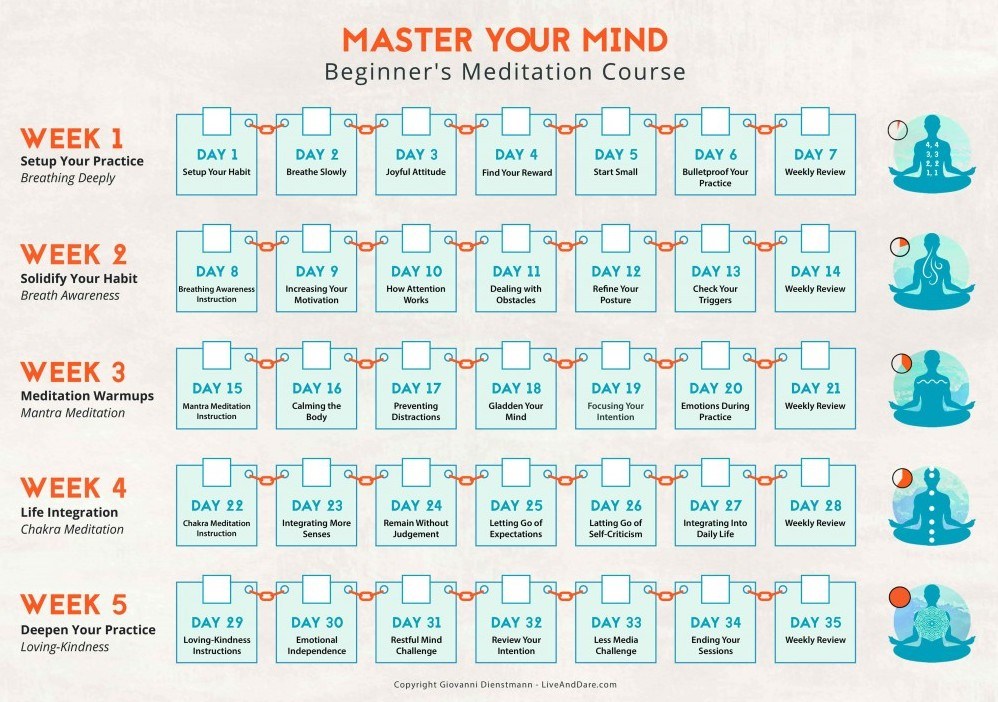
If you’re someone who learns better with a clear roadmap rather than figuring everything out on your own, I’d like to share a resource that I genuinely found helpful while researching beginner meditation courses.
I had the opportunity to go through a beginner-friendly meditation course by Giovanni Dienstmann. One thing I appreciated was how the course doesn’t expect you to master meditation overnight. Instead, it guides you through the journey one week at a time, helping you build your practice gradually instead of overwhelming you with too much information at once.
I’ve written a detailed review where I walk through the course, share what each week covers, and explain who I think it’s best suited for. If you’re curious, feel free to have a look.
👇Read my complete review of the Master Your Mind Beginner’s Meditation Course👇

The benefits of meditation extend far beyond relaxation. It can sharpen focus, strengthen resilience, support personal growth, and cultivate greater mindfulness in everyday life. Explore these handpicked guides to discover the best meditation courses for your experience level and aspirations.