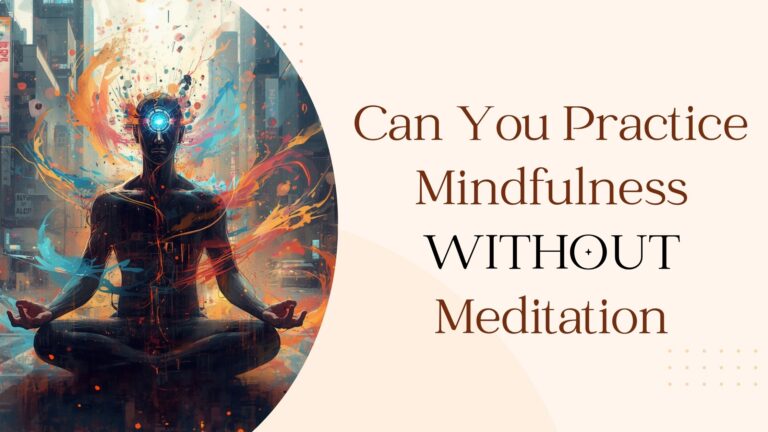
When I first started meditating, I assumed mindfulness and meditation were basically the same thing.
I thought mindfulness was something I practiced during those 10 or 15 minutes when I sat down to meditate. Once the session was over, I went right back to my usual routine, thinking about the past, worrying about the future, and letting my mind jump from one thought to another.
It wasn’t until later that I realized I was missing something important.
Meditation and mindfulness are closely related, but they aren’t the same thing.
Meditation is a formal practice that helps train your attention. Mindfulness is what happens when you bring that attention into your everyday life.
So, can you practice mindfulness without meditation?
Yes, you can.
In this article, I’ll explain the difference between mindfulness and meditation, why mindfulness doesn’t require formal meditation, and how you can start bringing more awareness into your daily life, even if you never sit down for a meditation session.
The Biggest Misunderstanding About Mindfulness
The biggest misunderstanding about mindfulness is that it’s something you do.
Many people think mindfulness is an activity, just like jogging, reading, or meditating.
I used to think that too.
In my mind, mindfulness was something that happened during meditation. If I sat quietly for 10 minutes and focused on my breath, I was being mindful. If I wasn’t meditating, I wasn’t practicing mindfulness.
But over time, I realized that mindfulness isn’t an activity at all.
It’s a way of paying attention.
Think about it this way.
- Walking is not mindfulness.
- Drinking tea is not mindfulness.
- Washing dishes is not mindfulness.
- Listening to music is not mindfulness.
These are simply activities.
What makes them mindful is the quality of attention you bring to them.
For example, you can drink a cup of tea while scrolling through your phone, thinking about tomorrow’s meeting, and barely noticing what you’re drinking.
Or you can drink the same cup of tea while noticing its warmth, aroma, and taste.
The activity is exactly the same.
The difference is where your attention is.
This was a huge realization for me because it changed how I thought about mindfulness.
I no longer saw it as something that only happened during meditation sessions. Instead, I began to see mindfulness as something I could practice throughout the day, regardless of what I was doing.
In other words, mindfulness isn’t about adding another task to your to-do list.
It’s about becoming more aware of the task you’re already doing.
And once I understood that, mindfulness suddenly felt much more accessible.
The Problem With Meditating for 10 Minutes & Forgetting About It
When I first started meditating, I treated it like a separate activity.
I would sit down, close my eyes, focus on my breath, and spend 10 or 15 minutes meditating. During those few minutes, I often felt calmer and more centered.
But then I would get up and continue with my day as if nothing had happened.
Within a short time, my mind would be right back where it had always been, jumping from one thought to another, replaying conversations, worrying about the future, and getting distracted by whatever grabbed my attention next.
Looking back, I realized I was making a mistake.
I was treating meditation as the destination when it was actually the training.
The purpose of meditation isn’t just to feel peaceful while you’re sitting on a cushion. The real value comes from what happens after the meditation session ends.
Think about learning to play a musical instrument.
You don’t practice for 20 minutes and expect those skills to disappear the moment you put the instrument down. The practice is supposed to improve how you play when it actually matters.
Meditation works in a similar way.
When you meditate, you’re training your ability to notice where your attention is, recognize when your mind has wandered, and gently bring it back.
Mindfulness is what happens when you use that skill in everyday life.
- It’s noticing that you’ve been worrying about tomorrow for the last five minutes and bringing your attention back to what you’re doing right now.
- It’s realizing that you’re eating a meal without even tasting it and choosing to become aware of the experience again.
- It’s catching yourself lost in thought while walking, working, or talking to someone and reconnecting with the present moment.
For me, this shift in perspective changed everything.
Instead of seeing mindfulness as something that only happened during meditation, I started viewing my entire day as an opportunity to practice awareness.
And the good news is that these moments don’t have to last long.
Even 30 seconds of intentionally paying attention can interrupt the cycle of endless thinking and create a small mental pause.
Those small moments may seem insignificant at first, but over time they can add up to a more mindful way of living.
Did you know that different meditation techniques can help address stress, anxiety, and trauma in unique ways? Explore these articles to learn which meditation courses may be most effective for your personal wellness goals.


The 4-Step Process I Use to Become More Mindful
Once I understood that mindfulness wasn’t limited to formal meditation, I started looking for simple ways to bring more awareness into my daily life.
Over time, I noticed that my mindfulness practice followed the same basic pattern again and again.
It’s not complicated, and you can do it almost anywhere.
Step 1: Notice That You’re Lost in Thought
The first step is simply noticing where your mind has gone.
Most of us spend a large part of the day thinking about something other than what we’re doing. We replay conversations, worry about the future, plan our next task, or get caught up in imaginary scenarios.
There’s nothing wrong with that. It’s what minds do.
The important thing is noticing when it’s happening.
For example, you might suddenly realize that you’ve been thinking about tomorrow’s meeting while brushing your teeth, or worrying about a problem while eating lunch.
That moment of noticing is the beginning of mindfulness.
Step 2: Bring Your Attention Back to the Present Moment
Once I notice that my mind has wandered, I gently bring my attention back to what’s happening right now.
Not to the past.
Not to the future.
Just to the experience I’m having in this moment.
I don’t try to stop my thoughts or force my mind to become quiet. I simply shift my attention back to the present.
Step 3: Use Your Senses as an Anchor
One of the easiest ways I’ve found to reconnect with the present moment is through my senses.
I might notice:
- What I can see around me
- What sounds I can hear
- Any smells in the environment
- The feeling of my feet on the ground
- The sensation of my hands touching an object
- The position of my body or posture
These simple observations help pull my attention out of my head and back into my actual experience.
Even a few seconds of doing this can make a difference.
Step 4: Continue With What You Were Doing
This is the part many people overlook.
Mindfulness doesn’t mean stopping everything and turning the moment into a meditation session.
After bringing my attention back, I simply continue with whatever I was doing.
I go back to drinking my tea.
I continue walking.
I return to my work.
I keep listening to the person I’m talking to.
The only difference is that now I’m a little more aware of what I’m doing.
That’s it.
No special equipment.
No perfect environment.
No 30-minute practice session.
Just noticing, returning, and continuing.
The more often I repeat this process throughout the day, the easier it becomes to step out of autopilot and reconnect with the present moment.
Does This Mean Formal Meditation Is Unnecessary?
Not necessarily.
While you can absolutely practice mindfulness without formal meditation, I still believe meditation has an important role to play.
The way I see it, meditation and mindfulness support each other.
- Meditation is where you train your attention.
- Mindfulness is where you use that attention in everyday life.
The stronger your ability to focus becomes during meditation, the easier it is to notice when your mind has wandered during the day. And the more you practice mindfulness throughout the day, the more naturally that awareness carries into your meditation sessions.
In that sense, the two work together.
That said, I don’t think you need to wait until you have a perfect meditation practice before you start becoming more mindful.
If formal meditation feels difficult right now, or if you simply don’t have the time for it, you can still begin practicing mindfulness today.
- You can notice your surroundings while taking a walk.
- You can pay attention while drinking your morning tea or coffee.
- You can become aware of your posture while working.
- You can take a few seconds to observe your breath while waiting in line.
These small moments of awareness may not seem like much, but they can gradually change your relationship with your thoughts and help you spend less time living on autopilot.
For me, one of the most important realizations was understanding that mindfulness isn’t something reserved for a meditation cushion.
It’s available in ordinary moments.
In the middle of a conversation.
While doing household chores.
During a walk.
While working at your desk.
Anywhere.
So, can you practice mindfulness without meditation?
Yes, you can.
But if there’s one thing I’d like you to take away from this article, it’s this:
Mindfulness isn’t about finding more time in your day. It’s about bringing more attention to the moments that are already there.
The benefits of meditation extend far beyond relaxation. It can sharpen focus, strengthen resilience, support personal growth, and cultivate greater mindfulness in everyday life. Explore these handpicked guides to discover the best meditation courses for your experience level and aspirations.