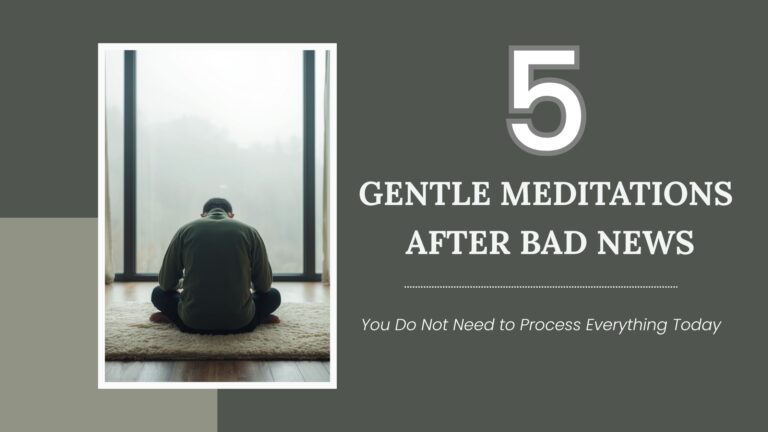
Sometimes bad news changes the entire feeling of a day in just a few seconds. A phone call, a message, a conversation, or even a medical update can leave the mind racing while the body feels heavy, numb, or unsettled. I think one of the hardest parts in those moments is that life still seems to continue around us while internally, everything feels paused.
That is what this article is really about.
In this post, I want to share five gentle meditation practices that can help during difficult moments like these. Some are grounding, some are calming, and some simply create a little breathing space when emotions feel too heavy to carry all at once. You do not need meditation experience for any of these practices, and you do not need to “do them perfectly” either.
Before You Begin: This Is Not About Forcing Calm
One thing I have personally noticed after receiving difficult news is that the mind immediately wants to “fix” the discomfort. Part of us wants answers, reassurance, certainty, or some way to quickly stop the emotional heaviness. And sometimes, even meditation can start feeling like another thing we are supposed to do perfectly in order to feel better.
But this article is not about forcing yourself to feel calm.
In fact, I think some of the most healing moments in meditation happen when we stop fighting our emotions for a few minutes and simply allow ourselves to breathe through them gently.
So before trying any of the meditations below, I want to mention a few important things:
- You do not need to empty your mind.
Racing thoughts are completely normal after upsetting news. - You do not need to stop crying or feeling emotional.
Meditation is not about pretending everything is okay. - You do not need long meditation sessions.
Even one quiet minute of grounding can help the nervous system slow down a little. - You can keep your eyes open if that feels safer.
Sometimes closing the eyes can feel overwhelming during emotionally intense moments. - You are allowed to pause at any time.
If a meditation feels too emotionally heavy, it is okay to stop and come back later.
I also think it helps to let go of the idea that meditation should instantly create peace. Sometimes after bad news, the goal is not deep relaxation. The goal is simply to create a small moment where the body feels supported instead of overwhelmed.
That small shift matters more than we often realize.
So as you move through these meditations, I invite you to approach them gently. Not as techniques to “fix yourself,” but as quiet practices that can help you stay connected to yourself during a difficult moment.
1. The “Pause Before Reacting” Breath Meditation
After receiving bad news, I often notice how quickly the body shifts into stress mode. The mind starts racing, the chest feels tight, and thoughts begin jumping from one fear to another. In moments like this, even one slow breath can feel grounding.
This meditation is not about creating a small pause before the mind spirals further.
When This Meditation May Help
- Racing thoughts
- Emotional shock
- Tightness in the chest
- Feeling panicked or overwhelmed
- Replaying the bad news repeatedly
Try This
Sit or stand in a comfortable position.
If it feels supportive, place one hand on your chest or stomach and begin noticing your natural breathing.
Then gently try this:
- Breathe in slowly through the nose for 4 seconds
- Exhale slowly through the mouth for 6 seconds
- Pause briefly
- Repeat a few times
As you breathe, you might quietly remind yourself:
- “I only need to be here for this breath.”
- “I do not need to solve everything right now.”
- “One moment at a time.”
I think these small reminders can help soften the feeling of urgency that often appears after difficult news.
If This Feels Difficult…
- Keep your eyes open
- Shorten the practice to just 3 breaths
- Try this while slowly walking
- Focus only on the exhale if deep breathing feels uncomfortable
You do not need a perfectly calm mind for this meditation to help. Sometimes a few slower breaths are enough to create a tiny sense of steadiness in the middle of emotional overwhelm.
2. Grounding Through Physical Sensations
After receiving difficult news, I sometimes notice how quickly the mind starts spiraling into future worries and unanswered questions. In moments like that, grounding through physical sensations can help bring a little attention back to the present moment.
When This Meditation May Help
- Racing thoughts
- Emotional overwhelm
- Feeling disconnected or mentally scattered
- Anxiety about the future
Try This
Instead of focusing on your thoughts, gently focus on physical sensations around you.
Notice:
- your feet touching the floor,
- your hands resting together,
- the feeling of your clothes against your skin,
- the temperature of the air around you.
You do not need to analyze anything deeply. Just notice each sensation slowly.
If it helps, silently name them:
- “Feet on the floor.”
- “Hands resting.”
- “Breathing in.”
- “Breathing out.”
Sometimes I find that even noticing one steady physical sensation can interrupt the feeling of mental chaos for a few moments.
If This Feels Difficult…
- Keep your eyes open
- Focus on just one sensation
- Hold a comforting object nearby
- Practice for only 30 seconds if needed
This practice is not about stopping your thoughts completely. It is simply a gentle way to remind yourself that you are still here, one moment at a time.
3. Hand-on-Heart Self-Compassion Meditation
Sometimes after receiving bad news, the hardest part is not just the situation itself, it is the way we speak to ourselves internally afterward. I have noticed that during emotionally painful moments, the mind can become very harsh, fearful, or self-critical without us even realizing it.
That is why I find self-compassion meditations so powerful during difficult times.
This practice is not about pretending everything is okay. It is simply about offering yourself a small moment of kindness while you move through something painful.
When This Meditation May Help
- Grief or sadness
- Emotional heaviness
- Fear or uncertainty
- Feeling alone or unsupported
- Self-blame or inner criticism
Try This
Sit somewhere comfortable and gently place one or both hands over your heart.
Take a slow breath and simply notice the warmth or pressure of your hand against your chest.
There is no need to force emotions to change.
Just breathe slowly and silently repeat a few gentle phrases like:
- “This is a difficult moment.”
- “I am allowed to feel what I feel.”
- “May I give myself kindness right now.”
- “I do not need to carry this perfectly.”
I think there is something deeply calming about combining physical touch with compassionate words. Sometimes the nervous system responds to gentleness more than pressure or control.
Stay here for as long as feels supportive.
If This Feels Difficult…
- Keep the phrases simple and natural
- Focus only on the feeling of your hand on your chest
- Replace the affirmations with slow breathing if words feel overwhelming
- Wrap yourself in a blanket or comforting object while practicing
You do not need to feel emotionally “better” after this meditation. Sometimes self-compassion simply helps us feel a little less alone inside our experience.
If stress, anxiety, or past experiences have been weighing on you, meditation can be more than just a habit. it can be a form of real support. But finding the right kind of guidance makes all the difference. Take a moment to explore the posts below, you might just find a meditation course that feels like it was made exactly for what you’re going through.

4. Walking Meditation for Restlessness
Sometimes after hearing difficult news, sitting still can feel almost impossible. I have noticed that emotional overwhelm often shows up physically too, pacing around the room, feeling restless, or carrying nervous energy in the body.
In moments like that, walking meditation can feel much gentler than forcing yourself to sit quietly.
This practice allows the body to move while the mind slowly settles into the present moment.
When This Meditation May Help
- Restlessness or nervous energy
- Feeling emotionally trapped or stuck
- Difficulty sitting still
- Racing thoughts
- Stress building up in the body
Try This
Find a quiet space where you can walk slowly for a few minutes.
As you walk, bring gentle attention to each step instead of getting pulled completely into your thoughts.
You might notice:
- your feet touching the ground,
- the movement of your legs,
- the rhythm of your breathing,
- the feeling of the air around you.
There is no need to walk perfectly slowly or “clear your mind.”
Just keep returning your attention softly to the experience of walking.
If it helps, you can silently repeat:
- “Step by step.”
- “I am here right now.”
- “One moment at a time.”
I think practices like this can feel comforting because they remind us that we do not always have to sit still to meditate.
If This Feels Difficult…
- Walk indoors if going outside feels overwhelming
- Practice for only 1–2 minutes
- Keep your attention only on your footsteps
- Let your pace feel natural instead of controlled
Sometimes movement itself becomes part of the healing process.
5. Naming What You Feel Meditation
One thing I have learned during emotionally difficult moments is that feelings can become even heavier when everything stays tangled inside the mind. Sometimes there is sadness, fear, anger, confusion, and exhaustion all happening at once.
This meditation creates space to gently acknowledge emotions instead of fighting them or pushing them away.
When This Meditation May Help
- Emotional confusion
- Feeling mentally overwhelmed
- Difficulty understanding what you feel
- Inner tension or emotional buildup
- Trying to suppress emotions
Try This
Sit quietly for a moment and take one slow breath.
Instead of trying to change your emotions, simply begin noticing what is present right now.
As feelings arise, gently name them in your mind.
For example:
- “Sadness.”
- “Fear.”
- “Anger.”
- “Confusion.”
- “Disappointment.”
There is no need to analyze the emotion deeply or judge yourself for feeling it.
Just acknowledge it softly and let it exist for a moment.
I think this practice can feel surprisingly relieving because naming emotions often reduces the pressure to keep carrying everything silently inside.
If This Feels Difficult…
- Start with broad words like “stress” or “hurt”
- Focus on one emotion at a time
- Place your hand on your chest while practicing
- Pause if emotions begin feeling too intense
You do not need to fully understand every feeling right now. Sometimes simply acknowledging what is present can create a little more emotional breathing room.
You Do Not Need to Process Everything Today
After receiving bad news, I think many of us quietly place pressure on ourselves to immediately “handle it well,” stay strong, figure everything out, or somehow regain emotional balance quickly.
But difficult moments rarely work that way.
Sometimes the mind needs time to absorb what has happened. Sometimes the body needs rest before clarity appears. And sometimes healing simply begins with giving ourselves permission to pause instead of forcing ourselves to have all the answers right away.
That is why I hope these meditations feel less like tasks to complete and more like gentle spaces you can return to whenever emotions feel heavy.
Even small things can matter right now:
- taking one slower breath,
- drinking water,
- stepping outside for fresh air,
- resting for a few minutes,
- reaching out to someone supportive,
- or simply allowing yourself to feel what you feel without judgment.
You do not need to process everything today.
And you do not need to move through this perfectly either.
Sometimes meditation after difficult news is not about finding immediate peace. It is simply about staying gently connected to yourself while life feels uncertain.
One breath.
One moment.
One small step at a time.
Struggling to find the right meditation course?
From building confidence to improving focus and productivity, these courses cover it all. Explore which one could spark the change you’re looking for!