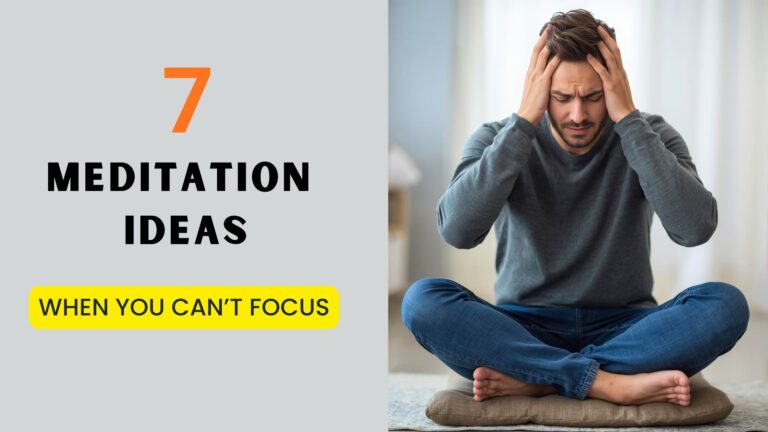
Some days, I sit down to meditate and within seconds my mind is everywhere. Thoughts jump from one thing to another, my attention drifts, and focusing on the breath feels almost impossible. If you’ve ever experienced this, you’re not alone. Meditation when you can’t focus can feel frustrating, especially when most advice simply tells you to “pay attention to your breath.” Over time, I’ve realized that the problem usually isn’t meditation itself, it’s that we’re trying the wrong approach for the state our mind is in.
In this article, I’ll share 7 simple meditation ideas I use when my mind refuses to settle, including techniques that work well for a distracted mind, racing thoughts, and moments when concentration just isn’t there. These practices are practical, beginner-friendly, and designed for those days when focusing feels like the hardest part of meditation.
1. Walking Meditation (When Sitting Feels Impossible)
There are days when I sit down to meditate and within a minute I feel restless. My legs want to move, my body feels uncomfortable, and staying still almost makes the mind more distracted. When this happens, I don’t force myself to sit longer. Instead, I switch to walking meditation.
Walking meditation works well when the body has excess energy. Rather than trying to suppress that restlessness, this practice allows the body to move while the mind gently settles. I’ve noticed that when my attention keeps drifting, focusing on the simple act of walking feels much easier than trying to concentrate on the breath while sitting still.
Here’s how I usually practice it:
- I find a quiet space where I can walk slowly for a few minutes.
- I begin walking at a relaxed pace.
- I bring my attention to the sensation of my feet touching the ground.
- When my mind wanders, I gently return my attention to the feeling of each step.
I don’t try to walk in a perfect or “meditative” way. The goal isn’t to control every thought. I simply keep returning my attention to the movement of walking. Many times, after a few minutes of this, I notice that my mind naturally becomes calmer and more present.
2. Breath Counting Meditation (When My Attention Keeps Drifting)
Sometimes when I try to meditate, my attention slips away almost immediately. I start following my breath, and before I know it, my mind has wandered off into plans, memories, or random thoughts. On days like this, I find that counting my breaths gives my mind just enough structure to stay engaged.
Breath counting works well when attention feels scattered because the counting acts like a gentle anchor. Instead of trying to hold the breath in awareness alone, the numbers give the mind something simple to follow. I’ve noticed that this small addition often makes it easier for me to stay present for a little longer.
Here’s how I usually practice it:
- I sit comfortably and take a few natural breaths.
- As I inhale and exhale, I silently count “one.”
- With the next breath, I count “two,” and continue up to ten.
- If my mind wanders or I lose track of the count, I simply start again from one.
I try not to treat the counting like a task I have to complete perfectly. If I lose track after three or four breaths, that’s completely fine. I just begin again from the start. Over time, I’ve found that this simple practice gently gathers my scattered attention and makes meditation feel much more manageable.
Struggling to find your meditation rhythm?
Discover what’s holding you back and how to calm your mind, plus learn the perfect daily meditation length for YOU!


3. Sound Awareness Meditation (When My Mind Is Racing)
There are times when my mind feels unusually busy. Thoughts appear one after another, and trying to focus on the breath only makes me more aware of how restless my mind is. When this happens, I shift my attention to sound awareness meditation.
I’ve found that listening to sounds is often easier than trying to hold a narrow point of focus. Sounds are already happening around us; a fan humming, birds outside, distant traffic, or even subtle background noises in the room. Instead of fighting my racing thoughts, I simply allow my attention to rest on whatever sounds arise.
Here’s how I usually practice it:
- I sit comfortably and allow my body to relax.
- I bring my attention to the sounds around me.
- Instead of searching for specific sounds, I simply notice whatever appears.
- When my mind gets caught in thoughts, I gently return to listening.
One thing that helps me is remembering that I don’t have to analyze or label the sounds. I’m not trying to figure out what they are or where they come from. I simply notice them as they arise and fade away. Over time, this simple act of listening often helps my racing mind slow down naturally.
4. Thought Labeling Meditation (When I’m Stuck in Overthinking)
There are moments when my mind keeps circling around the same thoughts. I might replay a conversation, worry about something in the future, or analyze a situation again and again. When this kind of overthinking takes over, simply trying to “stop thinking” rarely works for me. Instead, I use thought labeling meditation.
What I’ve noticed is that overthinking often becomes stronger when I get pulled deeply into every thought. Labeling thoughts helps create a little distance. Rather than following each thought wherever it goes, I simply recognize it and give it a gentle label.
Here’s how I usually practice it:
- I sit comfortably and begin observing my thoughts as they appear.
- When a thought arises, I quietly label it with a simple word such as “thinking,” “planning,” “remembering,” or “worrying.”
- After labeling the thought, I allow it to pass without continuing the story.
- I then return my attention to the present moment, often by noticing my breath or body.
I don’t try to eliminate thoughts during this practice. Instead, I treat them like passing events in the mind. Labeling them reminds me that a thought is just a thought, not something I have to chase or solve right now. Over time, this simple shift often softens the grip of overthinking and brings a little more space into the mind.
5. Hand-on-Heart Breathing (When I Feel Emotionally Overwhelmed)
There are times when the reason I can’t focus during meditation isn’t just a busy mind, it’s an emotional one. Maybe I’m feeling stressed, anxious, or simply overwhelmed by everything happening in the day. When my mind feels like this, I’ve noticed that trying to concentrate harder doesn’t help. What helps me more is switching to a softer practice like hand-on-heart breathing.
This meditation works well because it brings attention to both the breath and the body in a very gentle way. Placing a hand on the heart creates a sense of grounding and warmth. Instead of trying to control my thoughts, I focus on calming the nervous system first.
Here’s how I usually practice it:
- I sit comfortably and place one hand gently over the center of my chest.
- I begin taking slow, natural breaths.
- As I breathe in and out, I notice the subtle movement under my hand.
- If my mind wanders, I gently bring my attention back to the feeling of my hand and the rhythm of the breath.
I don’t try to change my emotions or push them away during this practice. I simply allow myself to breathe and feel the steady presence of my hand on the heart. Often, after a few minutes, I notice that the mind begins to soften and the body feels a little more at ease.
You’ve tried a lot, but have you found the right meditation course for your needs?
Explore these courses that can help you manage stress, overcome trauma, and ease anxiety, starting today!


6. 1-Minute Breathing Reset (When My Mind Feels Mentally Exhausted)
Sometimes the reason I can’t focus during meditation is simply that my mind is tired. Maybe it has been a long day, I’ve been staring at screens for hours, or my head feels overloaded with information. On days like this, even the idea of a full meditation session feels like too much. When that happens, I use a 1-minute breathing reset.
I’ve noticed that when my mind is mentally fatigued, trying to meditate for ten or twenty minutes often creates more frustration. A very short reset works better. One quiet minute of breathing is often enough to slow things down and bring a little clarity back to the mind.
Here’s how I usually practice it:
- I sit comfortably and set a simple intention to breathe slowly for one minute.
- I take a slow breath in through my nose.
- I gently exhale and allow my shoulders to relax.
- I continue breathing slowly, keeping my attention on the rhythm of each inhale and exhale.
I don’t worry about whether my mind stays perfectly focused during that minute. The goal isn’t perfect concentration. It’s simply to pause, breathe, and give my mind a small break. Surprisingly often, even this short reset helps me feel calmer and more present.
7. Open Awareness Meditation (When Concentration Just Won’t Come)
There are also days when none of the usual techniques seem to work. I sit down to meditate, but my mind refuses to settle on anything, not the breath, not sounds, not the body. When this happens, I stop trying to force concentration and shift to open awareness meditation.
Instead of focusing on one thing, this practice allows me to notice whatever is happening in the present moment. Thoughts, sensations, sounds, and emotions can all appear and pass without needing to be controlled. I’ve found that this approach works well when my mind feels too scattered to hold a single point of attention.
Here’s how I usually practice it:
- I sit comfortably and allow my attention to relax.
- Instead of choosing one focus, I simply notice whatever arises in my experience.
- A sound might appear, then a thought, then a sensation in the body.
- I let each experience come and go without trying to hold onto it.
I remind myself that I don’t have to control the mind during this practice. My only intention is to stay gently aware of what is happening right now. Ironically, when I stop trying to force focus, the mind often begins to settle on its own.
Final Thoughts
Over time, I’ve realized that struggling to focus during meditation doesn’t mean I’m doing something wrong. It simply means my mind is in a particular state that day. Some days it feels calm and steady, and other days it feels restless, distracted, or tired. That’s completely normal.
What has helped me the most is learning to adjust the type of meditation to the state of my mind. If sitting still feels impossible, I walk. If my thoughts are racing, I listen to sounds. If my mind feels exhausted, I simply take a minute to breathe.
Meditation doesn’t have to be perfect to be helpful. Even small moments of awareness can make a difference. So if you ever find yourself struggling with meditation when you can’t focus, you might try one of these simple approaches and see which one works best for you on that particular day.
Struggling to find the right meditation course?
From building confidence to improving focus and productivity, these courses cover it all. Explore which one could spark the change you’re looking for!