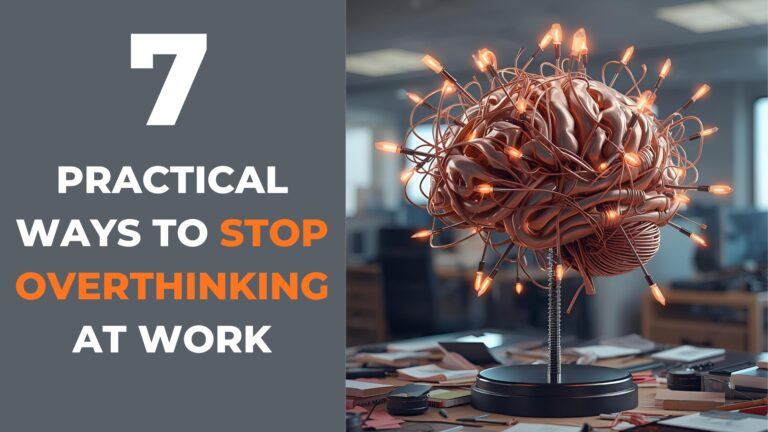
You know those moments when you’re staring at an email for way too long, rewriting the same line because you’re scared it might sound “off”? Or when your boss messages, “Can we talk?” and your mind instantly jumps to the worst outcome? These small spirals are exactly why so many people try to figure out how to stop overthinking at work, because the real challenge isn’t the job itself, but the mental noise that comes with it.
In this post, we’ll break down what overthinking really looks like in everyday work situations, why it happens, and practical ways to calm the mental loop so you can focus, make decisions faster, and feel more confident throughout your day.
TL;DR
- Overthinking at work often shows up as spiraling into “what ifs,” over-polishing tiny tasks, or replaying moments long after they’ve passed.
- This guide gives you 7 practical, real-life strategies to break the cycle without forcing yourself to “just stop thinking.”
- Here’s a quick preview of what you’ll learn:
- Spot when your mind shifts into worst-case mode
- Use small time limits to avoid decision spirals
- End the email-editing loop before it drains your energy
- Catch and interrupt replayed conversations
- Give your thoughts a safe place to “park”
- Challenge your inner critic using actual evidence
- Set boundaries with yourself so work thoughts don’t follow you home
- Each tip is simple, doable, and designed to help you think less and focus more during your workday.
Summarize this content with AI
1. Notice when your mind jumps to the worst-case scenario
Let’s be honest, most overthinking at work doesn’t start with a real problem. It starts with one tiny trigger.
Maybe your boss messages you and suddenly your brain is like, “Oh no… what went wrong?”
Or someone replies with a short Slack message and you’re instantly convinced they’re upset with you. These jumps happen so fast you don’t even realize you’ve slid into a negative story.
What’s actually happening here
Your brain is trying to “protect” you. It’s scanning for danger, scanning for mistakes, scanning for things that could go wrong, even when nothing is actually wrong.
It’s basically running on old templates: fear of judgment, fear of disappointing someone, fear of messing up. So instead of waiting for information, your mind fills in the blanks with the worst possible version.
How to fix it
When you catch your mind spiraling, pause and ask yourself:
“What else could be true?”
That simple question interrupts the panic loop.
It forces your brain to look for neutral or even positive interpretations instead of the dramatic one.
For example:
- “Can we talk?” could mean they need a quick update.
- A short message could mean they’re busy, not annoyed.
- A delayed email reply could mean they’re in a meeting, not avoiding you.
You’re not convincing yourself everything is perfect. You’re just balancing the story.
How to apply it at work (in a real, non-woo way)
The next time you feel that familiar drop in your stomach, try this quick reset:
- Name the spiral: “I’m assuming the worst again.”
- List three neutral or realistic alternatives.
- “Maybe they just need a quick clarification.”
- “Maybe they’re in back-to-back calls.”
- “Maybe it has nothing to do with me.”
- Wait before reacting.
Don’t rewrite the email. Don’t over-explain. Don’t panic-message your coworker.
Give the situation a little space. You’ll be surprised how often the “crisis” quietly disappears all by itself.
2. Set small time limits for everyday decisions
Some overthinking doesn’t come from big tasks. It comes from tiny decisions that shouldn’t take more than a minute. But somehow they do.
Micro-scene:
You’re choosing between two slide layouts for a presentation.
It’s a simple choice, but suddenly you’re zooming into fonts, checking spacing, wondering which one “looks more professional,” and 18 minutes disappear.
Not because the decision is hard… but because you’re afraid of choosing wrong. This is classic overthinking disguised as “being thorough.”
What’s actually happening here
Your brain is trying to eliminate risk. It wants a decision that guarantees no criticism, no mistakes, no negative feedback.
But work doesn’t operate that way. Most decisions are small, reversible, and not that deep.
The goal is not perfection.
The goal is progress.
How to fix it
Use what I call a Micro Deadline, a tiny, intentional time limit for decisions that don’t deserve your entire morning.
Here’s how it works:
- Give yourself 2 minutes to choose a layout.
- Give yourself 60 seconds to pick an email subject line.
- Give yourself 90 seconds to decide which task to start with.
These limits force your brain to stop spiraling into “What if…”
How to apply it at work (without stressing yourself out)
Try this simple approach:
- Identify a low-stakes decision.
Fonts, colors, slide layouts, email wording, which tool to use. Basically anything that won’t break the company. - Set a timer (mentally is fine).
Tell yourself: Two minutes. I’ll decide and move on. - Choose the first “good enough” option.
Not the perfect one.
Not the one you’ve over-analyzed.
The one that works. - Move to the next step immediately.
Don’t reopen the slide. Don’t rewrite the email. Just keep going.
Why this works so well
You train your brain to stop treating every decision like a life-or-death situation. And the more you practice this, the faster your mind stops falling into analysis paralysis. It’s simple, but surprisingly powerful.
3. Cut the “email perfectionism” loop
If overthinking had a favorite playground, it would be your inbox.
Micro-scene:
You write an email that should’ve taken 90 seconds.
But then you read it again.
And again.
You change one sentence… then change it back.
You add an emoji… then delete it.
Five minutes later, you’re still stuck on the tone, not the message.
Meanwhile, the person you’re emailing?
They’re skimming it on their phone while walking to the pantry.
What’s actually happening here
Perfectionism and fear of judgment often mix together when it comes to written communication.
Your brain wants the email to sound:
- confident
- not too confident
- polite
- not overly formal
- clear
- but not abrupt
And before you know it, you’re editing based on imagined reactions, not actual expectations.
How to fix it
Use a simple 3-step rule for emails that aren’t high-stakes:
- Write the email without stopping.
Don’t edit mid-sentence. Just get it out. - Do one quick skim for clarity.
Check if it makes sense. That’s it. - Send it.
Yes, even if you feel the urge to “read it one last time.”
If the email is internal or routine, this method will save you hours of unnecessary spirals every month.
How to apply it at work (especially if you overthink tone)
Here’s a practical, real-world approach:
- Set a 90-second limit for internal emails
(status updates, replies, clarifications, the usual stuff). - Use templates for common messages like follow-ups or approvals.
- Stop treating every email like a performance review.
Most workplace emails are skimmed, not studied.
And here’s a mindset shift that helps instantly:
Your tone isn’t judged nearly as much as you think. People just want the information.
Bonus tip for chronic email overthinkers
If you fear sounding rude, add one friendly line you use consistently, like:
- “Let me know if you need anything else.”
- “Happy to clarify if needed.”
- “Thanks for your time.”
This keeps your tone warm without rewriting the whole email three times.
Hope you’re finding this post useful! Want to take your mindfulness practice further? I have got some fantastic tools that could be just what you need. Give them a look and see how they can benefit you!



4. Catch yourself when you’re replaying old conversations
Sometimes the overthinking doesn’t happen during work. It happens after. Your body is at your desk, but your mind is still stuck in yesterday’s meeting.
Micro-scene:
You’re trying to start a task, but your brain keeps replaying that one moment you spoke up in the team call.
“Did I sound stupid?”
“Did I interrupt someone?”
“Should I have phrased it differently?”
Now 15 minutes have passed and you haven’t done a thing.
This replay loop is exhausting, and most of the time, it doesn’t change anything.
What’s actually happening here
Your brain is searching for signs you embarrassed yourself or made a mistake, even when nothing significant happened. It’s trying to “fix” the past by over-analyzing it, which is impossible.
This kind of mental looping usually comes from:
- fear of being judged
- past criticism or workplace experiences
- perfectionism
- wanting to be liked
Your brain thinks it’s being productive, but really, it’s draining your energy.
How to fix it
When you catch yourself replaying a moment, try this short grounding phrase:
“That moment has passed.”
It reminds your brain that:
- the situation is already over
- you cannot edit it
- you’re safe now
- continuing to analyze won’t change anything
It’s like pressing stop on a mental recording.
How to apply it at work (in a realistic, daily way)
Here’s what you can do when your mind starts replaying:
- Label the loop:
“I’m replaying that meeting again.” - Redirect your attention:
Look at the next task you need to do.
Even a small step (like opening the file) breaks the mental cycle. - Use a physical cue:
Placing your hand on your desk, taking one slow breath, or standing up for 10 seconds can help shift your focus back to the present. - Ask this helpful question:
“Is this helping me or just stressing me out?”
(99% of the time, the answer is obvious.)
Why this method works
You’re not fighting the thoughts. You’re simply reminding your brain that the moment is over and choosing to move forward instead of living in reruns.
5. Give Your Thoughts a “Parking Spot”
Picture this: You’re halfway through drafting an email when your brain suddenly taps you on the shoulder with, “Did you update the client spreadsheet? Did you respond to that message from yesterday? Should you rewrite the proposal? What if the client hates the presentation?”
Now you’re staring at your screen, your email is half written, and your mind is spinning like a browser with 47 tabs open.
This is classic overthinking triggered by competing thoughts. Your brain is trying to juggle everything at once, and instead of helping, it pulls you in five different directions.
What’s happening here
Your brain doesn’t like “open loops.” Any unfinished task, unanswered message, or unmade decision sends a little alert. When you’re trying to focus, these alerts stack up and boom, you’re overthinking.
How to fix it
Give your thoughts a designated “parking spot.”
This means anytime a random worry, idea, reminder, or thought interrupts you, you don’t entertain it, you park it.
You write it down immediately, even if it’s a tiny thing like:
- “Check the updated file”
- “Ask Ron about deadlines”
- “Confirm the meeting time”
The moment you put it somewhere outside your head, your brain stops trying to hold onto it.
How to apply it at work
- Keep a small notebook, sticky notes, or a digital spot (like Google Keep or the Notes app).
- The moment a thought pops up while you’re working, don’t argue with it, just write it down.
- Once you finish the task at hand, open your “parking spot” and deal with anything that actually matters.
This habit is ridiculously simple but unbelievably effective. Most people overthink because they’re trying to mentally keep track of everything. Once your brain knows it doesn’t have to remember, it stops obsessing.
Your mindfulness journey doesn’t have to stop here. Dive into the posts below for practical tips, real-life challenges, and simple ways to stay grounded, even on your busiest days.


6. Challenge your inner critic with evidence
Imagine you’re preparing for a team meeting, and suddenly your brain whispers, “You’re probably going to mess this up.”
A few minutes later, the whisper becomes a full announcement:
“What if they think your idea is stupid? What if you say something wrong? What if you look unprepared?”
Now you’re rehearsing imaginary disasters instead of your actual talking points.
What’s happening here:
Your inner critic jumps in the moment you feel uncertain. It speaks in extremes, assumes the worst, and presents opinions as facts.
And when you don’t question it, you start believing it, which fuels more anxiety, more self-doubt, and more overthinking.
How to fix it:
Put your inner critic on trial.
Don’t silence it.
Don’t fight it.
Just ask it one simple question:
“Where’s the evidence?”
You’ll notice something interesting, your inner critic rarely has any.
How to apply it at work:
Whenever you catch yourself spiraling into negative predictions, pause and ask these quick questions:
- “Has this actually happened before?”
(Most of the time, the answer is no.) - “What proof do I have that this will go badly?”
- “What proof do I have that it might go well?”
(Surprisingly, there’s often more proof on the positive side.) - “If my friend said this about themselves, what would I tell them?”
(We are kinder and more rational with others than with ourselves.)
For example:
Your brain says, “Your report is probably terrible.”
You check the evidence:
- You met the deadline.
- You followed the brief.
- You double-checked your data.
- Your previous reports have been appreciated.
Suddenly, the thought loses its power because facts speak louder than fear.
This practice helps you flip from emotion to evidence. Over time, your inner critic becomes less dramatic, and your mind becomes a much calmer place to work in.
7. Create boundaries with yourself, not just your job
Let’s say your official workday ends at 6 p.m.
But at 9:45 p.m., you’re still thinking about an email you sent earlier.
You’re lying in bed rehearsing a reply you might need to write tomorrow…
…or replaying something your manager said in a meeting…
…or worrying about the deadline next week even though you can’t do anything about it right now.
The office closes.
The laptop shuts down.
But your mind? Wide open.
What’s happening here
We often think boundaries are something we set with other people, declining extra tasks, not replying to late-night messages, saying no to overload.
But a huge part of overthinking comes from the boundaries we don’t set with ourselves.
Because even when work stops, the “work voice” keeps talking.
How to fix it
Start creating “internal boundaries,” which means setting limits on when you’re allowed to think about work and when you’re not.
This isn’t about pretending work doesn’t exist.
It’s about giving your brain permission to take a break.
How to apply it at work (and after work)
• Set a mental ‘office closing time.’
Pick a time when you stop allowing work thoughts to hijack your evening.
When a thought pops up after that?
Tell yourself: “I’ll save this for my work brain tomorrow.”
It sounds silly, but it works.
• Use a “parking lot note.”
If a task or worry pops up at the wrong time, write it down immediately.
This tells your brain: “Relax, I won’t forget. You can stop reminding me.”
• Create a 5-minute shutdown routine.
Before ending your workday:
- List what you finished
- List the top 3 things for tomorrow
- Close all tabs
- Close the laptop with intention
Your mind loves closure.
If you don’t give it one, it keeps spinning.
• Watch out for ‘fake productivity.’
Thinking about work isn’t the same as doing work.
But your brain doesn’t know that, it feels busy, so it keeps going.
A boundary helps you break that loop.
Why this helps with overthinking
When you set boundaries with your own thoughts, you train your brain to switch off.
This reduces mental clutter, reduces rumination, and keeps stress from spilling into your personal life.
Boundaries aren’t just about protecting your time. They’re about protecting your mind.
Final Thoughts
Overthinking at work doesn’t make you weak, unprofessional, or “bad at your job.” It usually means you care, sometimes a little too much, and your brain hasn’t learned how to switch off yet. And that’s okay.
What matters is that you now have a set of practical tools you can actually use in real moments: when your mind jumps to worst-case scenarios, when you feel stuck in loops, when you replay conversations, when your inner critic gets loud, or when work follows you home long after you’ve logged off.
If you try even one or two of these strategies, creating closure at the end of your day, separating fact from fear, doing micro-actions, setting internal boundaries. You’ll start noticing small shifts.
Less spiraling.
More clarity.
More confidence in your decisions.
And a workday that feels calmer, lighter, and way more doable.
You don’t have to stop caring.
You just have to stop letting your thoughts run the whole show.
And now you know exactly where to start.
Hey there! If you found this post helpful! I believe you’ll love these selected programs designed to elevate your mindfulness practice and enhance your well-being.