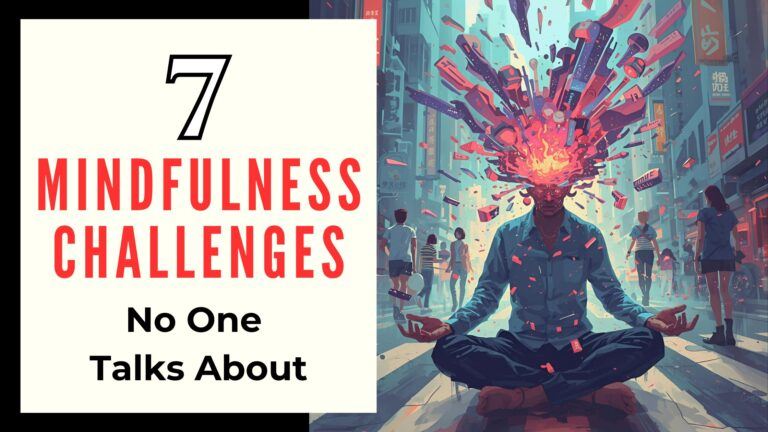
Did you know that mindfulness challenges you before it helps you? It’s something many people don’t talk about. It doesn’t instantly calm your mind or make you feel zen. In fact, at first, it often stirs up everything you’ve been avoiding i.e. restlessness, guilt, impatience, even old emotions you thought you’d buried.
That’s the secret no one tells you: these messy moments are mindfulness. They’re not proof that you’re failing they’re proof that you’re finally noticing what’s really happening inside.
In this post, we’ll explore seven common mindfulness challenges that almost every beginner faces, not the polished kind you see on social media, but the real ones that make you think, “This is me.” And we’ll look at how to work through them with more honesty, gentleness, and self-understanding.
TL;DR: Your Mindfulness Challenges (Quick Summary)
Mindfulness looks peaceful, but the truth is, it challenges you before it helps. Here are 7 common mindfulness challenges beginners face and how to work through them:
- “I’m Doing It Wrong” Anxiety – You’re not failing; distraction is part of learning.
- The Productivity Paradox – Mindfulness isn’t a tool to achieve more, it’s a way to be.
- The “Emotions I Was Avoiding” Flood – Old feelings surface; see it as emotional detox.
- The Guilt of Inconsistency – Missing practice isn’t weakness; it’s a natural rhythm.
- The “Spiritual Bypass” Trap – Mindfulness is about facing emotions, not escaping them.
- The Comparison Spiral – Your practice is yours; mindfulness isn’t a competition.
- The “Too Busy to Be Present” Reality – Presence starts by redefining what truly matters.
Takeaway: These struggles don’t mean you’re bad at mindfulness, they mean you’re actually doing it.
Summarize this content with AI
1. The “I’m Doing It Wrong” Anxiety
You sit down to be mindful, maybe close your eyes, take a few deep breaths and within seconds, your mind is everywhere.
You think about what to cook, an email you forgot to send, or that awkward thing you said three years ago.
Then comes the thought: “I can’t even meditate right.”
Sound familiar?
This is one of the most common mindfulness challenges – the fear that you’re doing it wrong.
Many beginners believe mindfulness means having a blank, peaceful mind. So when thoughts keep showing up, it feels like failure.
But here’s the truth:
- Wandering is what minds do.
- You’re not supposed to stop thinking, you’re learning to notice thinking.
- Every time you realize your mind has drifted and gently bring it back, that’s mindfulness.
If you remember one thing, let it be this:
You can’t fail at noticing.
The mind wandering isn’t a problem, it’s the opportunity.
2. The Productivity Paradox
You start practicing mindfulness because you want to feel calmer, more focused, or less stressed.
But after a few days, you find yourself thinking, “Why isn’t this working yet?”
That’s the productivity mindset sneaking in, the part of us that wants quick results and measurable progress.
We live in a world where everything is about efficiency and improvement, so it’s easy to treat mindfulness like another self-improvement project.
But here’s the twist:
The more you try to “achieve” calm, the more tense you become.
Mindfulness isn’t meant to be used to get somewhere. It’s meant to help you be where you already are.
When you turn it into a tool for performance, you miss its real purpose – presence.
Try this gentle shift in approach:
- Don’t sit down to “do” mindfulness; sit down to meet yourself.
- Let go of goals like “I’ll feel relaxed after this.”
- Notice what’s here right now, tension, noise, thoughts and let that be enough.
When you stop measuring your progress, something interesting happens:
Peace begins to appear on its own.
Looking to bring more calm and focus into your day? Check out these simple mindfulness routines and real-life tips to help you stay grounded, no matter what life throws your way.

3. The “Emotions I Was Avoiding” Flood
You finally slow down. Maybe you’re sitting quietly or taking mindful breaths and suddenly, it all hits you.
Old memories. Guilt. Sadness. Even anger you didn’t know you were carrying.
You think, “Wait… isn’t mindfulness supposed to make me feel better?”
This is one of the most surprising mindfulness challenges for beginners. When you stop running from moment to moment, everything you’ve been avoiding finally has space to show up.
And sometimes, that space feels uncomfortable.
Here’s the truth:
Mindfulness doesn’t create new pain – it reveals the pain that’s been waiting to be seen.
That can feel overwhelming at first, but it’s actually a sign that your awareness is deepening.
You’re beginning to notice what’s really happening inside instead of numbing or distracting yourself.
When strong emotions come up, try these gentle steps:
- Pause and name what you feel. Saying “this is sadness” or “this is fear” brings clarity and softness.
- Ground through your senses. Feel your feet on the floor or the weight of your body on the chair.
- Breathe into the feeling, not away from it. Give it permission to move through you.
Remember, emotions are like waves, they rise, peak, and eventually pass.
Let mindfulness be your surfboard, not your shelter.
You’re not failing when it feels hard; you’re healing.
4. The Guilt of Inconsistency
You start strong, meditating every morning, feeling proud that you’re finally doing it. Then life happens. Work gets busy, your sleep schedule slips, or you just forget.
A few days later, the guilt creeps in: “I was doing so well… and now I’ve failed.”
This is one of the most common mindfulness challenges, believing that missing practice means you’ve lost all progress. But mindfulness isn’t like a diet or a workout routine. You don’t “fall off” mindfulness. You simply pause awareness for a while.
Here’s what’s really happening:
Your practice didn’t disappear, it’s waiting for you to return.
Mindfulness has seasons. Some days you’ll feel deeply connected, and other days your attention will wander or fade. That’s completely natural.
Try looking at inconsistency differently:
- See it as part of the rhythm. Growth often happens quietly during breaks.
- Drop the perfection mindset. You don’t need a perfect streak to be mindful.
- Focus on returning, not performing. Every time you come back, you’re strengthening the muscle of awareness.
So instead of judging yourself for stopping, celebrate the moment you begin again.
Each return is proof that mindfulness still matters to you.
Consistency isn’t about never missing a day. It’s about remembering that you can always start again.
5. The “Spiritual Bypass” Trap
You’re upset about something, maybe an argument, stress at work, or a tough emotion bubbling up.
You take a deep breath and tell yourself, “It’s fine, I’ll just let it go.”
But deep down, it’s not fine. You’ve just used mindfulness as a quick escape hatch.
This is what’s known as spiritual bypassing, when we use mindfulness to avoid uncomfortable emotions instead of facing them. It feels peaceful in the moment, but over time, it builds quiet tension inside.
Here’s the tricky part:
Mindfulness isn’t about rising above your emotions, it’s about turning toward them.
Real mindfulness asks for honesty, not avoidance. Sometimes that honesty feels raw or inconvenient, but it’s what allows genuine healing to happen.
If you notice yourself using calmness to avoid what’s painful, try these gentle shifts:
- Acknowledge what’s underneath. Ask yourself, “What feeling am I trying not to feel right now?”
- Use the breath as support, not escape. Breathe with the emotion, not around it.
- Allow both truths to exist. You can be calm and still admit that something hurts.
Mindfulness doesn’t mean pretending everything’s okay.
It means being kind enough to face what isn’t.
The goal isn’t to stay unshaken. It’s to stay present with whatever’s real.
Want to feel more present, at work, at home, and in between? Explore simple mindfulness tips, beginner exercises, and fresh ways to stay calm and focused all day long.

6. The Comparison Spiral
You scroll through social media and see someone meditating on a mountain, sunlight glowing around them.
They look so peaceful, their space, their calm, their “morning ritual.” Meanwhile, you’re trying to meditate between chores, emails, or noise from the next room.
And quietly, you think: “I’ll never be that calm.”
This is the comparison spiral. One of the sneakiest mindfulness challenges out there.
It’s when mindfulness stops feeling like your own journey and starts feeling like a competition you’re losing.
Here’s the truth:
Mindfulness isn’t supposed to look a certain way, it’s supposed to feel honest.
You can’t see someone else’s inner world through a photo or post. What looks like peace might be a snapshot taken between their own messy, distracted moments, just like yours.
Try this gentle shift when comparison shows up:
- Return to your intention. Ask, “Why did I start practicing?”
- Remember: mindfulness is private work. No one can see your awareness but you.
- Unfollow the ideal. Your practice doesn’t need soft music or perfect lighting, it needs presence.
The real practice happens in imperfect spaces, in traffic, during stress, while washing dishes.
Mindfulness isn’t about how serene you look; it’s about how present you are when life isn’t serene.
When you stop comparing your calm to someone else’s image, you finally make space for your own authentic peace.
7. The “Too Busy to Be Present” Reality
You know mindfulness would help… but there’s always something more “urgent.” Work deadlines, errands, kids, laundry, life doesn’t exactly pause to let you breathe.
So you tell yourself, “I’ll practice when things slow down.” But they rarely do, right?
This is one of the most common mindfulness challenges. Feeling too busy to be mindful. Ironically, it’s when we’re busiest that we need mindfulness the most.
Here’s the hard truth:
Mindfulness doesn’t require more time, it requires more awareness of the time you already have.
You don’t have to sit cross-legged for 30 minutes to “count.” Try weaving mindfulness into what you’re already doing:
- While brushing your teeth, notice the taste, the sound, the sensation.
- While walking, feel your feet touch the ground.
- Before replying to a message, take one deep breath.
These tiny pauses are not “lesser” practices, they’re the building blocks of real mindfulness.
You don’t need a quiet morning routine or a perfect schedule. You just need a moment of noticing in the middle of your ordinary day.
Because mindfulness isn’t something to fit into your life —
It’s something that transforms the life you already have.
Final Thoughts: It’s About Presence & Not About Perfection
If you’ve faced any of these mindfulness challenges, you’re not doing it wrong, you’re doing it right.
Because every challenge you meet on this path is part of the practice itself.
Feeling distracted, restless, emotional, or inconsistent doesn’t mean you’re failing.
It means you’re noticing.
And that awareness, even when it’s uncomfortable, is mindfulness in action.
Here’s the truth most people don’t say out loud:
Mindfulness isn’t easy. It’s honest.
It’s the moment you admit, “This is where I am right now,” without needing it to look better or feel perfect.
And from that honesty, real change begins – quietly, gently, and naturally.
So the next time you catch yourself thinking, “I’m not good at this,” pause and remember:
You don’t have to master mindfulness. You just have to keep showing up, one breath, one moment, one gentle noticing at a time.
Hey there! If you found this post helpful! I believe you’ll love these selected programs designed to elevate your mindfulness practice and enhance your well-being.