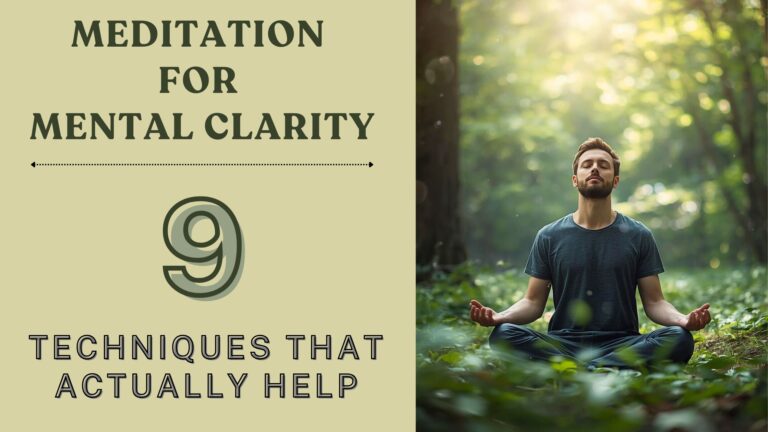
Some days, my mind feels so cluttered that even simple tasks start to feel overwhelming. I sit down to work, but my thoughts keep jumping from one thing to another, or everything just feels foggy and unclear. That’s exactly what led me to explore meditation for mental clarity, not just as a daily habit, but as a practical way to reset my mind when it feels off.
At first, I thought meditation was just about sitting quietly and focusing on my breath, but I quickly realized that one technique doesn’t work for every mental state.
In this post, I’ll share nine meditation techniques I personally use depending on how my mind feels, so you can find what actually helps you think clearly, focus better, and feel more in control.
Why One Meditation Technique Is Not Enough
For a long time, I believed I just needed to “get better” at one type of meditation.
So I kept trying the same thing, sitting still, focusing on my breath, and hoping my mind would calm down. Some days it worked. But on other days, it felt frustrating… like I was forcing something that just wasn’t clicking.
That’s when I started noticing something important.
Not all mental states feel the same.
- Some days, my mind is racing with thoughts I can’t slow down
- Other times, I feel mentally drained or foggy
- And sometimes, I just can’t focus no matter how hard I try
And expecting one meditation technique to fix all of these? It just doesn’t make sense.
I started looking at meditation differently.
Instead of asking, “What’s the best meditation?”
I began asking, “What does my mind need right now?”
That simple shift changed everything.
I realized that meditation works best when it matches how I’m feeling in the moment, just like you wouldn’t use the same approach for every problem in your daily life.
So rather than sticking to one method, I began using different techniques depending on whether I needed to calm my thoughts, clear mental fog, or improve focus.
And that’s exactly what I’ll help you do next.
How to Choose the Right Meditation (Quick Guide)
Once I stopped trying to force one meditation technique to work every time, things became much simpler.
Instead of overthinking it, I started asking myself one question:
“What does my mind feel like right now?”
That’s it.
From there, choosing the right meditation became more intuitive and honestly, much more effective.
To make this easier for you, here’s the same approach I use:
If your mind feels…like this…Try this…
- Racing with thoughts → Breath Awareness or Thought Labeling
- Foggy or mentally tired → Walking Meditation
- Easily distracted → Trataka (Candle Gazing)
- Overwhelmed or emotionally heavy → Body Scan Meditation
- Restless or anxious → Box Breathing
- Noisy or mentally cluttered → Sound Awareness Meditation
- Lacking direction or clarity → Visualization Meditation
You don’t need to analyze this too much.
Just pause for a moment, notice how your mind feels, and pick a technique that matches it.
That’s exactly how I approach meditation now, it’s less about doing it “perfectly” and more about choosing what actually helps in the moment.
And in the next section, I’ll walk you through each of these techniques step by step, so you can start using them right away.
1. Breath Awareness Meditation (for scattered thoughts)
When my mind feels scattered and I can’t seem to focus on even simple tasks, this is the first technique I come back to. It’s simple, grounding, and honestly one of the most effective forms of meditation for focus I’ve used.
When I Use This
I use this when:
- My thoughts are jumping from one thing to another
- I keep getting distracted while working
- I feel restless but don’t know why
It’s that mental state where nothing feels clear, and I just need something to anchor my attention.
How I Do It (Simple Steps)
- I sit comfortably and close my eyes (or keep them slightly open)
- I bring my attention to my breath, just noticing it as it is
- I focus on the sensation of breathing (nose, chest, or belly)
- When my mind wanders, I gently bring it back to the breath
- I repeat this for a few minutes without trying to control anything
What Helped Me Make It Work
What made a big difference for me was not trying to control my breath.
In the beginning, I used to force slow, deep breaths, thinking that’s what I was supposed to do. But that only made me more aware of “doing it right.”
Once I started just observing my natural breath instead of changing it, everything felt easier and more calming.
Common Mistake to Avoid
- Trying to stop your thoughts completely.
- I used to think that if my mind wandered, I was doing it wrong. But that’s not the goal. Your mind will wander, that’s normal.
- What matters is simply noticing it and coming back to your breath, again and again. That’s where the real benefit comes from.
2. Thought Labeling Meditation (for overthinking)
When my mind gets stuck in loops, replaying conversations, worrying about the future, or analyzing everything, I use this technique. It’s one of the simplest ways I’ve found to break the cycle of meditation for overthinking without trying to suppress my thoughts.
When I Use This
I use this when:
- I can’t stop overthinking the same thing
- My mind keeps jumping into “what if” scenarios
- I feel mentally exhausted from too many thoughts
It’s especially helpful when my thoughts feel loud and hard to ignore.
How I Do It (Simple Steps)
- I sit quietly and notice whatever thoughts are coming up
- Instead of getting involved, I gently label each thought
- For example: “thinking,” “planning,” “worrying,” or “remembering”
- After labeling, I let the thought pass without engaging further
- I keep repeating this as new thoughts come up
What Helped Me Make It Work
What really helped me was keeping the labels simple and neutral.
At first, I tried to analyze my thoughts too deeply, which just pulled me back into overthinking. But once I started using basic labels like “thinking” or “worrying,” it created a small gap between me and my thoughts.
That gap made it easier to let them go.
Common Mistake to Avoid
- Getting caught up in the story of the thought.
- It’s easy to start labeling a thought and then immediately drift into analyzing it. I’ve done that many times.
- The key is to label it lightly and move on, no judgment, no deep dive. Just notice it and let it pass.
Feeling like meditation just isn’t “clicking” for you? You’re not alone, and more importantly, you’re not doing it wrong. In fact, the struggles, doubts, and messy moments you’re experiencing might be the very signs that you’re on the right path. Take a moment to explore the posts below, you might just discover that your meditation journey is unfolding exactly as it should.


3. Trataka (Candle Gazing Meditation)
When I feel like I can’t focus at all, especially when my eyes and mind both feel restless, this is the technique I turn to. Trataka is a simple yet powerful form of concentration meditation that helps me bring my attention back to one point.
When I Use This
I use this when:
- I keep getting distracted while working or reading
- My mind feels restless and unfocused
- I struggle to stay with one thing for more than a few seconds
It’s especially helpful when focusing on the breath feels too subtle or difficult.
How I Do It (Simple Steps)
- I light a candle and place it at eye level, about an arm’s distance away
- I sit comfortably and gently gaze at the flame
- I try to keep my eyes steady without blinking too much
- If my eyes get tired, I close them and visualize the flame
- After a few moments, I open my eyes and repeat
What Helped Me Make It Work
What made this easier for me was not trying to stare intensely.
In the beginning, I thought I had to keep my eyes completely still, which just created strain. But when I softened my gaze and treated it more like observing rather than forcing focus, it felt much more natural.
That’s when I noticed my attention becoming more stable.
Common Mistake to Avoid
- Forcing your eyes to stay open or overstraining.
- It’s okay to blink or close your eyes when needed. This isn’t about pushing yourself, it’s about gently training your focus.
- If you treat it too strictly, it can become uncomfortable instead of helpful.
4. Walking Meditation (for brain fog)
When my mind feels dull, heavy, or just foggy, sitting still doesn’t always help. That’s when I switch to walking meditation. It’s a simple form of mindfulness for clarity that helps me wake up my mind while staying present.
When I Use This
I use this when:
- My mind feels sluggish or unclear
- I’ve been sitting too long and can’t think straight
- I feel low on energy but still need mental clarity
It’s especially useful when I don’t feel like sitting down to meditate at all.
How I Do It (Simple Steps)
- I start walking slowly in a quiet space (indoors or outdoors)
- I bring my attention to the sensation of my feet touching the ground
- I notice each step; lifting, moving, and placing my foot down
- If my mind wanders, I gently bring it back to the movement
- I continue this for a few minutes at a relaxed pace
What Helped Me Make It Work
What helped me most was slowing down more than I normally would.
At first, I walked at my usual pace and didn’t notice much difference. But when I intentionally slowed down and paid attention to each step, it became much easier to stay present.
That’s when the mental fog started to lift.
Common Mistake to Avoid
- Treating it like a regular walk.
- It’s easy to start thinking about other things or checking your phone while walking. I’ve done that too.
- The key is to stay connected to the experience of walking, not the destination or your thoughts.
Not sure if you’re breathing correctly… or wondering whether guided or silent meditation is actually better for you? You’re asking the right questions. Sometimes, it’s these small uncertainties that lead to the biggest breakthroughs. Explore the posts below, you might just find the missing piece that makes meditation finally feel right (and maybe even life-changing).


1) 7 Breathing Mistakes you might be making in meditation 2) Guided Meditation vs Silent Meditation 3) 9 Reasons why meditation is life changing
5. Body Scan Meditation (for mental overload)
When my mind feels overloaded, like there’s just too much going on at once. I’ve noticed that trying to “think my way out of it” doesn’t help. That’s when I use a mindfulness meditation body scan to shift my attention out of my head and into my body.
When I Use This
I use this when:
- I feel mentally overwhelmed or emotionally heavy
- My thoughts feel tangled and exhausting
- I can’t relax, even when I try to sit still
It’s especially helpful when my mind feels crowded and I need a reset.
How I Do It (Simple Steps)
- I lie down or sit comfortably and close my eyes
- I bring my attention to my feet and notice any sensations
- Slowly, I move my attention upward (legs, stomach, chest, arms, head)
- I don’t try to change anything, just observe what I feel
- If my mind wanders, I gently bring it back to the body
What Helped Me Make It Work
What really helped me was not trying to relax on purpose.
In the beginning, I kept checking if my body was “relaxed enough,” which actually created more tension. But when I simply focused on noticing sensations, without trying to fix anything, I naturally started to feel calmer.
That shift made this practice much more effective.
Common Mistake to Avoid
- Trying to force relaxation.
- It’s easy to think this meditation is about making your body feel a certain way. I used to do that too.
- But the goal isn’t to relax instantly, it’s to become aware. Relaxation often follows, but only when you stop trying to control it.
6. Box Breathing (for instant mental reset)
When my mind feels tense, anxious, or just overwhelmed, I don’t always have the patience for longer meditation. That’s when I use box breathing. It’s one of the simplest breathing exercises for clarity I’ve used to quickly reset my mind and regain control.
When I Use This
I use this when:
- I feel anxious or mentally overwhelmed
- My thoughts are racing and I need a quick reset
- I need to calm down before starting a task
It’s especially helpful in moments when I need clarity fast.
How I Do It (Simple Steps)
- I inhale slowly for a count of 4
- I hold my breath for 4 seconds
- I exhale slowly for 4 seconds
- I hold again for 4 seconds
- I repeat this cycle for a few minutes
What Helped Me Make It Work
What made this effective for me was keeping the count steady and comfortable.
At first, I tried to force longer breaths, thinking it would work better. But that just made me feel more tense. Once I stuck to a natural rhythm (like 4 seconds), it felt calming instead of stressful.
Consistency mattered more than intensity.
Common Mistake to Avoid
- Forcing your breath too much.
- It’s easy to think you need to take very deep or long breaths for this to work. I’ve made that mistake too.
- But the goal is steady, controlled breathing, not pushing yourself. Keep it simple and relaxed.
If stress, anxiety, or past experiences have been weighing on you, meditation can be more than just a habit. it can be a form of real support. But finding the right kind of guidance makes all the difference. Take a moment to explore the posts below, you might just find a meditation course that feels like it was made exactly for what you’re going through.


7. Sound Awareness Meditation (for calming mental noise)
When my mind feels noisy, like there’s a constant stream of thoughts in the background, I don’t always try to quiet it down directly. Instead, I shift my attention to sound. This simple practice helps me step out of my thoughts and into the present moment.
When I Use This
I use this when:
- My mind feels busy or mentally cluttered
- I can’t seem to “switch off” my thoughts
- Silence feels uncomfortable or distracting
It’s especially helpful when focusing on the breath feels too subtle or difficult.
How I Do It (Simple Steps)
- I sit comfortably and allow my awareness to open up
- I start noticing the sounds around me (near and far)
- I don’t label or judge them, just listen
- If a thought comes up, I gently return to listening
- I continue observing sounds as they come and go
What Helped Me Make It Work
What really helped me was not trying to find specific sounds.
At first, I kept searching for something interesting to focus on. But when I allowed all sounds, background noise, distant voices, even silence between sounds, it became much easier to stay present.
It felt less like effort and more like awareness.
Common Mistake to Avoid
- Trying to block out certain sounds.
- It’s natural to get annoyed by noises, especially loud or sudden ones. I used to resist them too.
- But this practice works best when you include all sounds as part of the experience, rather than fighting them.
8. Visualization Meditation (for clear thinking)
When my thoughts feel scattered or I can’t seem to think clearly about something, I use visualization meditation. It helps me gently guide my mind instead of letting it wander aimlessly. Over time, I’ve found this to be a very effective form of visualization meditation for improving clarity.
When I Use This
I use this when:
- I feel mentally unclear or indecisive
- My thoughts are all over the place
- I need a sense of direction or focus
It’s especially helpful when I want to organize my thinking without overanalyzing.
How I Do It (Simple Steps)
- I sit comfortably and close my eyes
- I take a few natural breaths to settle in
- I visualize a simple, calming image (like a clear sky or still water)
- I keep my attention on that image as steadily as I can
- If my mind wanders, I gently return to the image
What Helped Me Make It Work
What made this easier for me was keeping the visualization very simple.
At first, I tried to create detailed mental images, which just made it harder to focus. But when I switched to something basic and calming, it became much easier to stay with it.
Simplicity made the biggest difference.
Common Mistake to Avoid
- Trying to visualize something too complex.
- It’s easy to think you need a vivid or detailed image for this to work. I’ve tried that and it usually leads to frustration.
- Stick to something simple and steady. The goal isn’t imagination, it’s clarity.
9. Noting Distractions Meditation (for staying focused)
When I’m trying to focus on something and keep getting pulled away by distractions, this is the technique I use. It’s a slightly more advanced practice, but once I simplified it, it became one of the most effective ways for me to stay focused without frustration.
When I Use This
I use this when:
- I’m working on something important but keep getting distracted
- My attention keeps drifting without me realizing it
- I want to build stronger focus over time
It’s especially useful when distractions feel constant and hard to control.
How I Do It (Simple Steps)
- I choose a simple anchor (usually my breath or a task I’m doing)
- Whenever I get distracted, I quickly “note” what pulled my attention
- For example: “thinking,” “noise,” “urge,” or “distraction”
- I don’t go deeper into it, I just acknowledge it
- Then I gently bring my attention back to the anchor
What Helped Me Make It Work
What really helped me was keeping the noting quick and light.
At first, I would pause too long to figure out the “right” label, which only created more distraction. But once I treated it like a quick mental tap, just noticing and moving on, it became much smoother.
That small shift helped me stay focused without overthinking the process.
Common Mistake to Avoid
- Overanalyzing the distraction.
- It’s easy to start labeling something and then get pulled into why it happened or what it means. I’ve done that many times.
- But the goal here isn’t to understand every distraction, it’s to notice it and return your focus. Keeping it simple is what makes it work.
How to Make These Techniques Work
By now, you might be thinking, “This all sounds helpful… but how do I actually make this work in real life?”
I had the same question.
What I’ve learned over time is that it’s not about doing all 9 techniques perfectly, it’s about using them in a way that fits into your day and your mental state.
Here’s what made the biggest difference for me:
Start with just one or two techniques
- In the beginning, I tried to remember everything and ended up doing nothing consistently.
- What worked better was picking one or two techniques that matched what I was struggling with most (like overthinking or lack of focus) and sticking with those for a few days.
- Once that felt natural, I explored others.
Match the technique to how you feel
This is the most important shift.
Instead of forcing yourself to meditate a certain way, pause and ask:
“What does my mind need right now?”
If I feel foggy, I don’t sit still, I go for walking meditation.
If my thoughts are racing, I use breath awareness or labeling.
This simple check-in makes meditation feel more effective and less like a chore.
Don’t worry about doing it perfectly
- There were times I felt like I was “bad” at meditation because my mind kept wandering.
- But that’s completely normal.
- The goal isn’t to have a perfectly clear mind, it’s to notice when your mind drifts and gently bring it back. That’s the practice.
Be consistent, not intense
What helped me most wasn’t doing long or intense sessions. it was showing up regularly, even in small ways.
A few minutes each day is far more effective than doing a long session once in a while.
At the end of the day, meditation for mental clarity isn’t about forcing your mind to be quiet.
It’s about learning how to work with your mind, one small step at a time.
Struggling to find the right meditation course?
From building confidence to improving focus and productivity, these courses cover it all. Explore which one could spark the change you’re looking for!