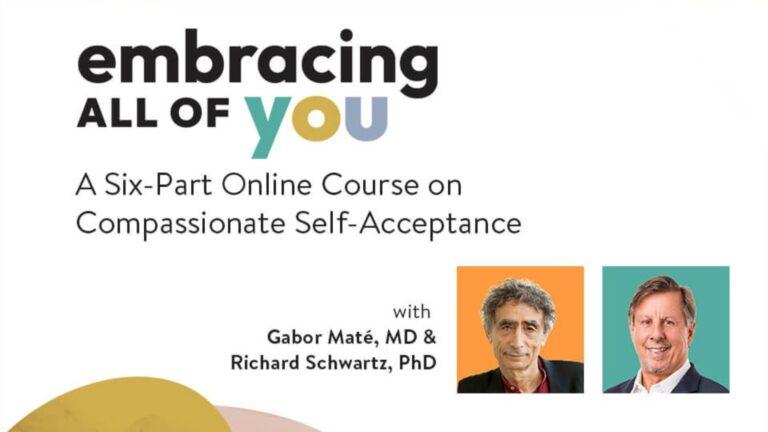
Emotional triggers and inner conflict can feel confusing, one moment everything is fine, and the next you’re overwhelmed by reactions you can’t fully explain. That’s what first led me to explore the Embracing All of You course, taught by Dr. Gabor Maté and Dr. Richard Schwartz.
While I haven’t taken the course myself, I was drawn to it because of my interest in trauma-aware healing. The reflections below are based on the published curriculum, session outlines, and the teachers’ work
What immediately stood out from the course description is how both teachers focus on the parts of ourselves we often push away, the wounded parts, the reactive parts, the parts that carry pain or shame. Based on the curriculum, it appears to offer a gentle invitation to look inward with fewer judgments and more compassion.
While reviewing the session outlines, I kept reflecting on my own patterns:
- the moments when I look calm but feel chaos building inside,
- the times when I react before I understand why,
- the old stories that still get triggered in unexpected ways.
Based on the curriculum, the course seems designed for people who want to understand those moments more deeply, not by forcing change, but by learning how to meet each inner part with curiosity and kindness.
Throughout this review, I’ll share my genuine impressions based on the published course materials, what personally resonated with me, and who I think would benefit most, all from the perspective of someone exploring the material rather than having completed it.
What This Course Is Really About
When I first looked at the course, what stood out immediately was the collaboration between Dr. Gabor Maté and Dr. Richard Schwartz, two experts whose work I’ve admired. The course materials, along with their body of work, demonstrate the depth and care they bring to helping people understand themselves better and heal long-held wounds.
The course is structured in six self-paced sessions, and it covers some big themes:
- How our early life experiences shape the way we see ourselves and the world
- The tools and approaches used in Internal Family Systems (IFS) and Compassionate Inquiry (CI)
- Understanding addictive behaviors, trauma, and their impact on mental and physical health
- Exploring how inner healing can lead to spiritual growth and self-discovery
What I personally found fascinating is the way the course isn’t just about theory. According to the course description, the sessions include actual demonstrations of healing work with CI and IFS. Reading about these examples, I could imagine how witnessing such a process might feel and how the approach could be applied in everyday life.
My reflection: One thing that really resonated with me is the idea of embracing all parts of yourself, including the parts that feel messy, rejected, or difficult. That’s something most of us struggle with quietly. Just knowing that a course can guide you to meet these parts with compassion felt reassuring, even from an outside perspective.
Key Takeaways from Each Session
The course is divided into six sessions, each focusing on a different part of self-discovery and healing. Going through the session summaries, I found myself reflecting on my own experiences and patterns. Here’s what stood out in each session:
Session One: Introduction
This session is described as setting the stage by exploring how Gabor Maté and Richard Schwartz’s early life experiences shaped their work.
- Takeaway: Our past influences how we see ourselves and relate to the world.
- Reflection: Reading this made me pause and think about my own triggers and how childhood experiences might still shape my reactions today.
Session Two: Overview of Internal Family Systems (IFS)
Here, the focus is on understanding the different “parts” of ourselves, the wounded, protective, and sometimes conflicting aspects.
- Takeaway: Accepting and caring for these inner parts can bring relief and a sense of inner peace.
- Reflection: The curriculum emphasizes that inner conflicts aren’t meant to be fought against but approached with curiosity and compassion, which resonated with me.
Session Three: Overview of Compassionate Inquiry (CI)
The curriculum describes this session as exploring a trauma-informed approach to understanding the mind-body connection and how stress affects our health.
- Takeaway: Emotional triggers and physical reactions often carry messages about past wounds.
- Reflection: The description of CI prompted me to reflect on how the body can ‘remember’ past stress, highlighting the mind-body connection emphasized in the course materials.
Session Four: Trauma, Addiction, and Mental Health
According to the session description, this addresses addiction and emotional patterns, highlighting that addiction is often relational rather than just medical.
- Takeaway: Understanding the root causes of our behaviors is key to long-term healing.
- Reflection: This session reminded me that it’s easy to judge our own reactions or coping patterns, but compassion changes the way we relate to them.
Session Five: Physical Illness and Disease
This session as described in the curriculum explores how stress and trauma can influence chronic illness and physical health.
- Takeaway: Healing isn’t only mental, nurturing the body is part of the process.
- Reflection: Reading this made me think about how my own stress might show up physically, and how self-compassion could be a form of medicine.
Session Six: Spiritual Discovery and Realization of Self
The final session focuses on connecting with your true nature and exploring spiritual growth through self-awareness.
- Takeaway: Healing and self-discovery can open doors to deeper peace and presence.
- Reflection: The curriculum presents the idea that embracing all parts of ourselves, even the messy ones, can foster a greater sense of wholeness and inner calm, which resonated with me.
Who This Course is Best For
From what I’ve read and from the course materials, this course seems especially helpful for anyone who:
- Struggles with emotional triggers or inner conflict
If you often feel overwhelmed by reactions you don’t fully understand, the course offers a way to explore why these patterns exist and how to respond with compassion rather than judgment. - Wants to heal from past trauma
Both Internal Family Systems (IFS) and Compassionate Inquiry (CI) focus on understanding and caring for the wounded parts of ourselves. Even reading about these approaches reminded me how powerful it can be to gently face and embrace the parts we usually hide. - Is curious about the mind-body connection
The course explores how stress, trauma, and unresolved emotions affect physical and mental health. For anyone interested in understanding how their inner world shapes their outer experience, this course provides a thoughtful framework. - Seeks personal growth and self-discovery
Beyond healing, the course invites you to explore spiritual growth, presence, and inner peace. If you’ve been looking for guidance on connecting with your true self, the program offers insights from two highly respected experts. - Prefers a self-paced, reflective approach
Since it’s an online course, you can move at your own pace, revisit sessions, and absorb the teachings on your own schedule, which is great if you want to reflect deeply without feeling rushed.
I feel this course could be a safe space for anyone who wants to approach themselves with curiosity and kindness, especially if you’ve ever felt frustrated by your own emotional patterns or wished you could understand yourself better.
Pros & Cons
Exploring the curriculum and descriptions gave me a good sense of the potential strengths and a few points to consider. Here’s my take:
Pros
- Two respected experts in one course: The collaboration between Dr. Gabor Maté and Dr. Richard Schwartz is rare and inspiring. Seeing their approaches, Compassionate Inquiry and Internal Family Systems, presented together feels like a unique opportunity for deep learning.
- Holistic approach: The course doesn’t just focus on the mind; it links emotional patterns, trauma, and physical health, which is rare and feels very thoughtful.
- Self-paced learning: Being able to move through the six sessions at your own pace is a huge advantage for those who need time to reflect, absorb, and revisit key concepts.
- Practical insights: Even reading the session breakdown, it’s clear that the course emphasizes practical ways to work with inner parts, emotional triggers, and self-compassion.
- Gentle, non-judgmental tone: From the course description, it seems designed to create a safe and supportive space for exploring difficult emotions, something that can feel rare in online learning.
Cons
- Not hands-on unless you actively practice: Since it’s online and self-paced, the full experience depends on your willingness to engage and reflect. Some may find it less structured than in-person work.
- Deep material can feel intense: Topics like trauma, addiction, and inner conflict can be emotionally heavy. The course likely requires readiness and openness to face challenging emotions.
- No direct guidance included: While the demonstrations are valuable, those who need more interactive feedback may feel the absence of one-on-one support.
Final Thoughts
From what the curriculum suggests, this course isn’t just about learning techniques or theories. It’s about inviting yourself to meet all parts of who you are, even the parts that feel difficult, wounded, or confusing. For anyone who has struggled with emotional triggers, inner conflict, or the desire to understand themselves more deeply, this program seems like a gentle yet profound guide.
What resonates most with me is the course’s emphasis on curiosity and compassion over judgment. It’s a reminder that healing doesn’t have to be forced. It’s a process of embracing yourself fully, step by step.
If you feel called to explore your inner world, deepen self-understanding, and learn from two of the most respected voices in trauma-informed healing, this course could be a meaningful next step on your journey.
Please note I receive compensation if you click on any links mentioned in this post to purchase a product or service from a third-party website. Also, purchasing a product or service from the above links does not increase your purchase price, however, it is a great way to thank me if you enjoy my content and find my suggestions useful. I only recommend products and services that I have personally used or thoroughly researched.
