
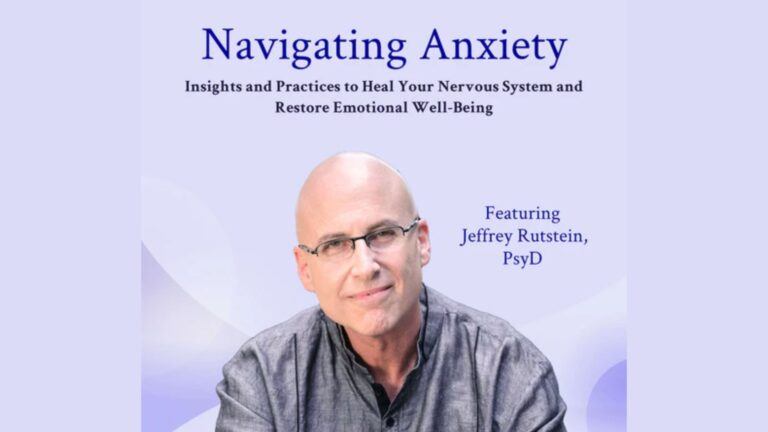
Anxiety can feel exhausting, confusing, and deeply personal, especially when it shows up again and again despite your best efforts to “manage” it. Many people end up blaming themselves for feeling anxious, as if something is fundamentally wrong with them. The Navigating Anxiety course review you’re reading today looks at a very different perspective. Created by trauma therapist Dr. Jeffrey Rutstein, this online training approaches anxiety not as a flaw or failure, but as a natural response shaped by the nervous system and past experiences.
In this post, we’ll explore what the course offers, how it works, and who it may genuinely help, so you can decide whether this compassionate, body-based approach to anxiety feels right for you.
What Is the Navigating Anxiety Course?
The Navigating Anxiety course is a three-hour online training created and taught by Dr. Jeffrey Rutstein, PsyD, a trauma therapist who specializes in nervous system regulation and trauma-informed healing. Rather than focusing on “fixing” anxiety, this course takes a more compassionate approach, helping you understand why anxiety happens and how to work with it safely.
At its core, the course is designed to help you feel safer in your body, especially during moments of stress, fear, or overwhelm.
Here’s a quick overview of what the course includes:
- Instructor: Dr. Jeffrey Rutstein, PsyD (Trauma Therapist)
- Format: Online Workshop
- Approach: Trauma-informed, nonjudgmental, and body-based
- Primary focus: Anxiety, nervous system dysregulation, and chronic overwhelm
Instead of treating anxiety as something “wrong” with you, Dr. Rutstein explains it as a natural survival response shaped by your nervous system and life experiences. The course draws heavily on Polyvagal Theory, but it’s explained in a way that feels accessible, even if you’re completely new to nervous system work.
What also sets this training apart is that it’s not just theoretical. The course is experiential and exercise-based, meaning you’re guided through:
- Somatic (body-based) meditations
- Simple breathwork practices
- In-the-moment tools to help calm reactivity and overwhelm
These practices are meant to be used in real life, especially when anxiety shows up unexpectedly. Overall, Navigating Anxiety is less about controlling your symptoms and more about building a kinder, more supportive relationship with your nervous system.
What You Learn Inside the Course
The course focuses on helping you understand your anxiety and respond to it in more supportive ways, especially when it feels overwhelming or out of your control. Instead of overwhelming you with theory, Dr. Jeffrey Rutstein combines clear explanations with practical, body-based exercises you can actually use in daily life.
Here’s what you’ll learn inside the course:
A New Way to Understand Anxiety
One of the most important shifts this course offers is how you view anxiety itself. You’ll learn that anxiety is not a personal weakness or something that needs to be eliminated, but a protective response of the nervous system.
Inside the training, you’ll explore:
- Why anxiety and stress responses are universal and human
- How your nervous system reacts to perceived or anticipated danger
- Why anxiety often shows up even when nothing seems “wrong” on the surface
This understanding alone can reduce a lot of self-blame.
How Nervous System Dysregulation Shows Up in Everyday Life
The course helps you recognize how dysregulation affects your thoughts, emotions, and behaviors, often without you realizing it.
You’ll gain clarity on:
- What nervous system dysregulation actually means (in simple terms)
- How past experiences and trauma influence present-day anxiety
- Why overwhelm, shutdown, or constant alertness can become habitual patterns
This awareness makes it easier to respond with compassion rather than frustration.
Expanding Your “Window of Tolerance”
A key concept taught in the course is the window of tolerance, the range in which your nervous system can handle stress without becoming overwhelmed.
You’ll learn:
- How anxiety narrows your window of tolerance over time
- Practical ways to gently expand your capacity to stay regulated
- How to notice early signs of activation before anxiety escalates
This is especially helpful if anxiety tends to spiral quickly for you.
Somatic Tools to Work With Anxiety in the Moment
Rather than relying only on mental strategies, this course emphasizes body-based practices that help calm the nervous system directly.
You’re guided through:
- Somatic meditations that build a sense of safety in the body
- Breathwork practices to reduce reactivity and stress
- Simple grounding techniques you can use on the spot, even during busy days
These tools are designed to be accessible and gentle, not forced or intense.
Building Inner Resources Like Resilience and Self-Compassion
Another important part of the course is learning how to reconnect with your inner strengths, especially during anxious moments.
You’ll practice:
- Using curiosity instead of judgment when anxiety arises
- Developing greater self-compassion toward your stress responses
- Recognizing your nervous system’s natural capacity for resilience
This helps shift your relationship with anxiety from resistance to cooperation.
Who This Course Is Best For
The course is especially helpful for people who want to understand their anxiety more deeply, without being told to simply “think positive” or push through it. If you’re looking for a gentler, more compassionate approach, this course may be a good fit.
This course is best suited for you if:
- You experience chronic anxiety or ongoing overwhelm
If anxiety feels like a constant background presence rather than an occasional issue, the nervous-system-focused approach can be particularly supportive. - You often blame yourself for feeling anxious
The course repeatedly reinforces that anxiety is not a personal failure, helping you replace self-judgment with understanding. - You’re interested in a trauma-informed perspective
If you want to explore how past experiences may still affect your stress responses, without reliving or analyzing them in detail. This approach feels respectful and safe. - You’re curious about somatic or body-based practices
This is a good fit if you’re open to working with breath, body awareness, and gentle movement rather than relying only on mental techniques. - Talk-based methods haven’t fully worked for you
If traditional advice or cognitive strategies haven’t brought lasting relief, learning to work directly with the nervous system may feel like a missing piece. - You want practical tools you can use in everyday moments
The practices taught are simple and realistic, designed to help during real-life situations like stress, reactivity, or emotional overload.
Overall, this course is ideal for people who want to build a kinder relationship with their anxiety and learn how to feel more grounded and safe in their body over time, without pressure to “fix” themselves.
Who This Course May Not Be For
While the course can be deeply supportive for many people, it’s not the right fit for everyone. Being clear about this upfront can help you decide whether this approach truly aligns with what you’re looking for right now.
This course may not be the best choice if:
- You’re looking for quick fixes or instant relief
This training focuses on gradual nervous system awareness and regulation. If you want fast hacks or immediate symptom elimination, this approach may feel too slow or subtle. - You prefer purely cognitive or mindset-based strategies
The course emphasizes body-based and somatic practices. If you’re not open to working with physical sensations, breath, or nervous system cues, it may not resonate. - You’re expecting one-on-one therapy or clinical treatment
Navigating Anxiety is an educational course, not a substitute for personalized therapy, diagnosis, or crisis support. - You want a highly structured, step-by-step “system”
The teaching style is experiential and reflective rather than rigid. If you prefer strict routines, checklists, or measurable milestones, this may feel too open-ended. - You’re not comfortable slowing down or tuning inward
Some exercises involve pausing, noticing internal sensations, and staying present with mild discomfort. If this feels frustrating or unsafe for you at this time, it may not be the right moment for this work.
That said, not being ready for this course doesn’t mean it won’t be helpful in the future. Many people find that nervous system–based work becomes more valuable once they’re ready to approach anxiety with patience and self-compassion.
Final Verdict
If you’ve been stuck in a cycle of anxiety, self-blame, and overwhelm, then the course offers a refreshing and compassionate alternative. Rather than trying to “fix” your anxiety, this training helps you understand what your nervous system is trying to do and how to support it more gently.
What makes this course worth considering is its trauma-informed, body-based approach. Dr. Jeffrey Rutstein doesn’t frame anxiety as something to overcome through willpower. Instead, he guides you toward building safety, awareness, and resilience from the inside out, at a pace that feels respectful and manageable.
Here’s why this course stands out:
- It reduces self-blame around anxiety by reframing it as a survival response
- It focuses on nervous system regulation, not symptom suppression
- The practices are simple and practical, suitable for everyday situations
- The teaching style is calm and nonjudgmental, which matters when you’re already overwhelmed
That said, this course is best viewed as a supportive learning experience, not a quick solution. If you’re open to slowing down, listening to your body, and working with anxiety rather than fighting it.
Overall, Navigating Anxiety is worth it for those seeking a gentle, trauma-sensitive way to relate to anxiety with more understanding and less fear, especially if traditional approaches haven’t fully addressed what you’re experiencing.
Please note I receive compensation if you click on any links mentioned in this post to purchase a product or service from a third-party website. Also, purchasing a product or service from the above links does not increase your purchase price, however, it is a great way to thank me if you enjoy my content and find my suggestions useful. I only recommend products and services that I have personally used or thoroughly researched.
